Ontario Animal Health Network (OAHN)
Companion Animal Network Team
Veterinary Need-2-Know (N2K) Update – May-Aug 2025
OAHN summer survey and lab data: Key results
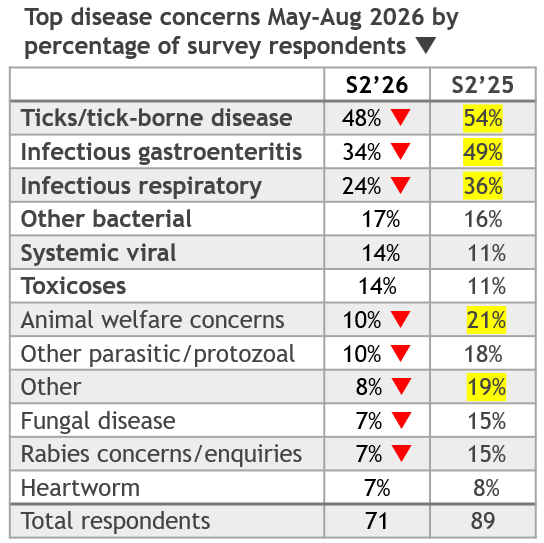 There were 71 survey respondents from 31 counties, including primary care, referral, mobile and emergency practices. Ticks and tickborne diseases once again topped the infectious disease concerns, and the seroprevalence for Borrelia and Anaplasma exposure continues to climb steadily as per the Ontario data posted on CAPCvet.org and graphed by OAHN. Pics of almost 1600 ticks found on animals in ON were submitted to etick.ca between May-Sep (check out the etick map). The Ontario risk area map for Blacklegged ticks has also been updated on the OAHN Ticks & Lyme Disease infographic. There were also multiple survey comments regarding heartworm cases around Eastern ON/Ottawa. Overall practitioners reported a relatively quiet period for infectious diseases.
*NEW* Vaccine timing & intervals resource: Many companion animal vaccine products no longer specify a duration of immunity (DOI) or revaccination interval on the label, instead advising consultation with a veterinarian. There are many factors to consider when determining an appropriate vaccination schedule for pets that don’t make it to the clinic “on time” for their regular vaccines (and we know that happens a lot!). OAHN has developed an infotable and infosheet to assist veterinarians with making vaccination decisions for patients based on what evidence is and is not currently available, their professional judgement, and individual considerations for patients and clients within an established veterinarian-client-patient relationship (VCPR). Be sure to login to OAHN to download these and other resources!
Rabies update: Raccoon rabies on the doorstep
Quebec and northern New York State continue to battle a raccoon rabies outbreak that has seen multiple incursions across the Canada-US border. Two rabid cats have also been detected in SW Quebec as a result of spillover infections. Although no cases have been detected in Ontario since 2023, a significant number of cases have been found across the river along our Eastern border. The Ontario Ministry of Natural Resources has increased their wildlife oral rabies vaccine (ORV) baiting efforts in key areas of Eastern Ontario, and they continue to seek partnerships with those (including veterinary clinics!) who can assist with short-term storage of potential wildlife surveillance samples in the area. Contact the MNR wildlife health Infoline (888-574-6656) if you’d like more information!
Although the final numbers have yet to be tabulated, it was a record summer for rabies response calls on both the veterinary and public health side of things. An increase in reported potential exposures (not cases) was also reported in the US. However, in Ontario there were actually fewer positive bats in July/August 2026 than the same period in 2025 (38 vs 72). This is in part due to lower testing numbers, likely because of stricter adherence to risk assessment guidelines, implemented to avoid overwhelming our decreased laboratory capacity. Know what bat encounters are and are not considered a significant risk for rabies transmission, for both people and pets!
Veterinarians seeking assistance with rabies risk assessments, sample submission and post-exposure management guidance for domestic animals can reach OMAFA via the rabies response request form on the Rabies: Information for Veterinarians webpage. Also check out the latest OAHN veterinary risk assessment guide for bats vs domestic animals as well as all the other tools on the Rabies Resource Page for Veterinarians (OAHN login required).
Have you found a brown dog tick?
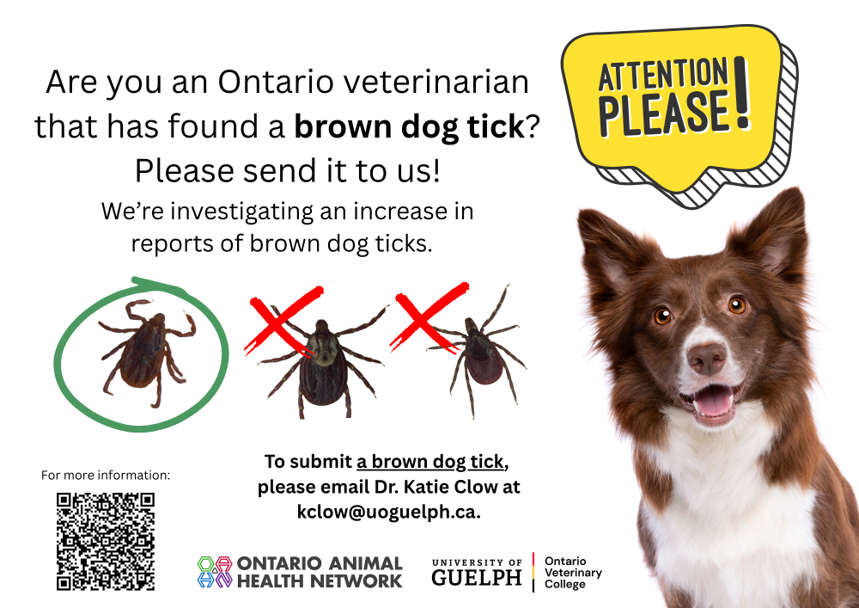
Remember! We want your Brown Dog ticks (Rhipicephalus sanguineus)
If you find any BDTs (or anything you think might be a BDT) on a resident dog in Ontario, please cap it (in a container), snap it (in a picture) and contact us or Dr. Katie Clow (kclow@uoguelph.ca).
For more information on this new OAHN project, check out the project webpage!
Update: RMSF near Long Point ON
A serosurvey for R. rickettsii antibodies in dogs in the Long Point area was conducted this summer as part of an OAHN project lead by Dr. Scott Weese, following the detection of multiple cases of Rocky Mountain Spotted Fever (RMSF) in dogs and people associated with this area in 2025. Preliminary results indicate that 5-10% of the dogs tested in May/June were previously exposed to the pathogen. Tick dragging in the area also detected positive D. variabilis ticks, but at a lower prevalence than in 2025. The question now becomes whether and how far the pathogen has spread beyond this region in Ontario. Be on the lookout for dogs with compatible signs and travel history, and reach out via the OAHN disease reporting portal or to Dr. Scott Weese if you see suspicious cases.
Echinococcosis: New pups & rescue dogs
Intestinal Echinococcus multilocularis (EM) has been detected in a record 8 dogs so far this year, 6 of which were 4 months of age or younger, and at least 6 of which had recently been purchased / rescued from western Canada, where the prevalence of EM is even higher. New dog owners should be alerted to the risk of EM and have at-risk dogs tested and/or treated for tapeworms
using a product containing praziquantel. Remember that dogs are typically infected by eating rodents, but it is the eggs in the dog’s feces that are infectious to people. Don’t eat poop!
Fall migration: Look out for HPAI again
After a blissfully quiet spring and summer with no confirmed cases of H5N1 influenza in Ontario poultry since mid-February, the fall wild bird migration season is upon us again. It is important to remain vigilant for cases in pets and livestock (especially cats and dairy cattle), and to use sound every-day infection control practices to avoid potential transmission of any flu viruses between animals and people – including seasonal flu. A recent paper from California highlights the risks of zoonotic transmission between affected cats and veterinary staff. Don’t forget to get your flu shot! OAHN is still offering influenza A surveillance testing in at-risk feral / outdoor cats until December 2026.
CAHSS smallholder webinars – FREE!
The Canadian Animal Health Surveillance System (CAHSS), in collaboration with WeCAHN (OAHN’s western counterpart), is offering a FREE six-session webinar series for Canadian smallholder producers of small ruminants, swine and poultry (Wednesdays, October 7 to November 18, 2 sessions per species). The sessions will focus on disease prevention, detection and response (complete description on the CAHSS website). A prime opportunity for animal owners, and a great refresher for any veterinarian who may work with backyard herds / flocks – or pets!
Last call: RHD testing
Subsidized testing is still available for rabbit hemorrhagic disease virus (RHDV) in suspect wild and domestic rabbits through our OAHN project, which will conclude December 2026. No cases have been detected in Ontario since 2022, but cases have occurred in Quebec (2024) and Saskatchewan (2026), so it is important to remain vigilant, and to vaccinate rabbits against this deadly disease.
Complaint to stop raw pet food company, US
In August, the US Department of Justice filed a “complaint” to shut down manufacturing and sales of a raw pet food company, after failure to respond to repeated warnings from the FDA based on finding Salmonella, Listeria, and STEC in product samples, with links to multiple human illnesses. The infectious disease risks from feeding raw diets are clear, and they are exacerbated by companies that fail to take responsibility for (or even acknowledge) the risks from their products by issuing recalls when warranted, and trying to improve their manufacturing processes for the safety of pets and the people around them. If you have clients that still want to feed their pets raw diets, make sure they know the risks and how to mitigate them. There is lots more information on the Worms & Germs Blog, and the OAHN / W&GB raw meat diets infosheet.
PHAC has posted a summary of the 2025 Salmonella outbreak in people in Canada associated with raw dog food and treats. The investigation wrapped up in Jan-2026, following a product recall.
Help us help you!
Have an idea for an infographic you’d like to see, or a podcast you’d like to hear? Email oahn@uoguelph.ca to let us know!