OAHN Companion Animal Network Team
Veterinary Need-2-Know (N2K) Update – Sep-Dec 2025
OAHN winter survey and lab data: Key results
There were 107 survey respondents from 36 counties, including primary care, referral, mobile and emergency practices. Several respondents from different regions reported increased blastomycosis cases in dogs, including multiple fatalities. Ticks and tickborne diseases remained the most common infectious disease concern, with 9% of total respondents reporting a “major” increase in cases compared
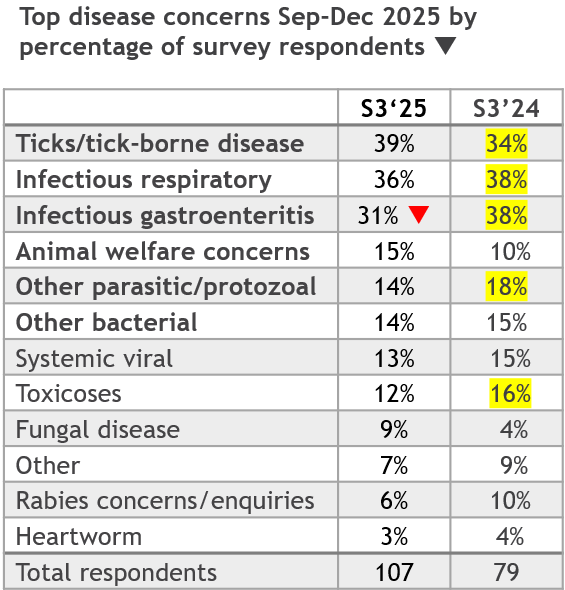
to last year. Respondents also reported decreased use of proper preventative medications due to affordability concerns as well as current pet “fads”. One such a fad that made the rounds again in 2025 was the promotion of ultrasonic tick repellants as a chemical-free means of preventing tick bites in pets, but there is still no sound evidence of efficacy of these devices.
Tick borne disease transmission times:
With the identification of ticks in Long Point ON infected with Rickettsia rickettsii and seroprevalence rates indicating increasing exposure to Anaplasma spp. among dogs in Ontario, regular tick checks (particularly after outdoor activities in or near high-risk tick habitats) remain vital to protecting pets. Effectiveness of many tick preventatives (oral and topical) is based on ticks being killed or detaching within 24-48 hours of biting, which is usually sufficient to prevent transmission of B. burgdorferi (36-48 h), but may be too slow to prevent transmission of Anaplasma spp. (24-36 h) or R. rickettsia (4-6 h, or less). It is also worth considering use of topical tick repellants in some pets to prevent bites.
Rabies update: “Bat” news, good news
A record 115 rabid bats were detected in Ontario in 2025, but more bats were tested than in any previous year since 2009. The percent positivity rate was actually decreased compared to 2024 (12% vs 18%). Bats remain the highest risk rabies reservoir species in Ontario. It is important to be aware of what bat encounters are (e.g. direct contact with a live bat) and are not (e.g. being in a room with a bat, even asleep) considered a significant risk for rabies transmission, for both people and pets!
No cases of raccoon variant rabies have been detected in Ontario since 2023, but there have been two cross-border incursions of this variant in Southern Quebec since December 2024, and one case on Wellesley Island NY in 2025, just across the river from Eastern Ontario, so stay vigilant!
The last case of fox-variant rabies detected in southern Ontario was in 2018; based on ongoing surveillance efforts, this has led to the publication of a paper detailing the over 70-year journey to eliminate fox variant rabies from southern Ontario. That’s HUGE! However, there remains an ever-present risk of Arctic fox variant rabies in arctic and sub-arctic habitats across Canada. Two recent cases of translocation of rabid dogs from northern to southern regions of Canada – a dog moved from Sanikiluaq NU to Winnipeg, and a dog moved from Umiujaq QC to Montreal – also clearly illustrate how risks in one region can have wide-reaching effects.
H5N1 influenza: Spike in wild birds, dog in AB
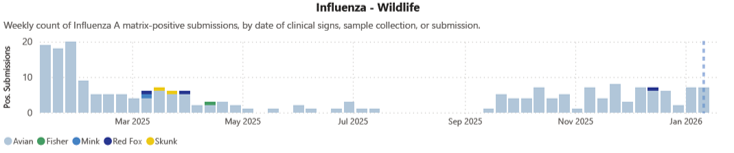
Although there were relatively few outbreaks of H5N1 avian influenza in Ontario poultry in 2025 (9 premises in total), wild bird mortalities have rivaled the numbers seen when the virus first hit the province in 2022. A report of a second fatal H5N1 infection in an immunocompromised dog in Alberta following partial consumption of an infected goose is another reminder of the importance of keeping pets away from wildlife and potentially highly contaminated areas where infected birds may gather (especially waterfowl, but also other birds like crows). Companion animal veterinarians must maintain vigilance for this virus, particularly in cats that may have direct or indirect exposure to the virus. Testing is available through commercial labs for cats, dogs and exotics. Surveillance testing is also still available for eligible cats (including barn cats and other outdoor cats) through the OAHN AIV in feral cats surveillance project, which has been extended to December 2026.
CAPCvet graphs: Lyme & Anaplasma serotrends
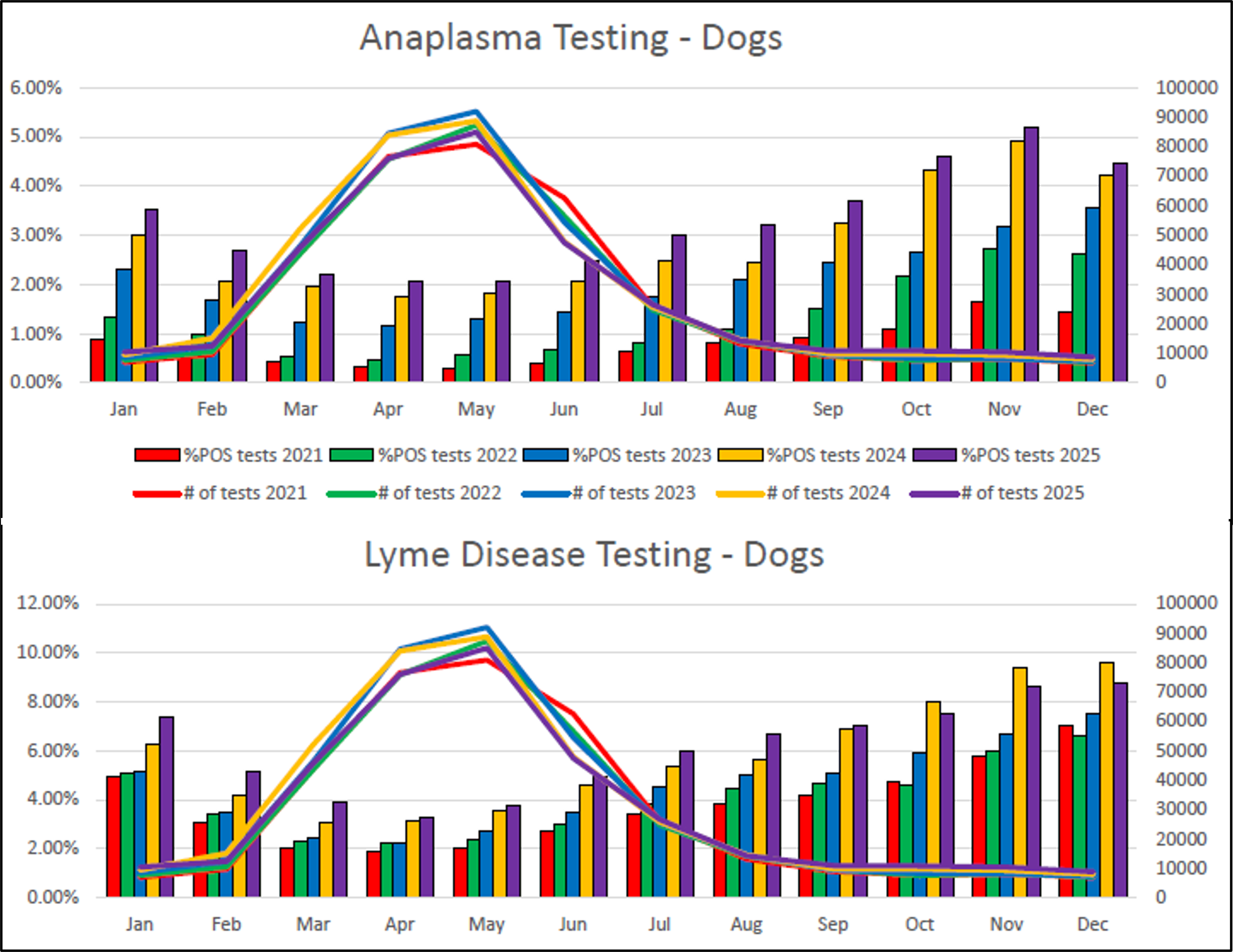
CAPCvet.org publishes monthly maps based on serological and fecal testing of select pathogens in dogs and cats by some of the major diagnostic labs in the US and Canada. Although the data only represent a fraction of the testing done in each area (estimated at approximately 30%), they still provide useful insight into local parasite activity. OAHN also posts graphs of these data for Ontario to help visualize trends over time. Check them out!
In the last 5 years, annual testing numbers have been very consistent, with the most testing in the spring, but there has been a steady increase in the annual percent seropositivity among dogs for both B. burgdorferi and Anaplasma spp. (approximately 2% for each in total). This fits with the OAHN clinical impressions survey results, in which respondents regularly comment on increasing rates of exposure to (and sometimes clinical disease from) both these pathogens.
Alert: Melarsomine
Production of the heartworm treatment drug melarsomine (marketed in Canada as Immiticide, BI) is being discontinued globally due to high cost of production. Stock available in Canada is anticipated to last through 2026, but going forward the drug will only be available in the US (marketed as Diroban, Zoetis). It is hoped that Canadian veterinarians will still be able to access the drug from the US via the emergency drug release (EDR) process, but discussion of these details has yet to take place. This product withdrawal may increase the use of “slow kill” protocols for infected dogs.
Stay tuned for more details!
Resource reminders
Veterinarians seeking assistance with rabies risk assessments, sample submission and post-exposure management guidance for domestic animals can reach OMAFA via the rabies response request form on the Rabies: Information for Veterinarians webpage!
Subsidized testing is still available for rabbit hemorrhagic disease virus (RHDV) in suspect wild and domestic rabbits through our OAHN project, which will conclude December 2026.
If you see highly unusual cases or clusters of animals with potentially infectious diseases, you can share the details with OAHN quickly and easily via our companion animal disease reporting portal. All submissions are reviewed by members of the network team to detect any notable disease patterns and occurrences that should be communicated to Ontario veterinarians.
Help us help you!
Have an idea for an infographic you’d like to see, or a podcast you’d like to hear? Email oahn@uoguelph.ca to let us know!