Ontario Animal Health Network (OAHN)
Companion Animal Network Team
Veterinary Need-2-Know (N2K) Update – Jan-Apr 2026
OAHN spring survey and lab data: Key results
There were 81 survey respondents from 49 counties, including primary care, referral, mobile and emergency practices. Overall infectious disease concerns were noticeably lower than the same period in 2025; as usual, ticks and tickborne diseases were the most common infectious disease concerns, with 15% of total respondents reporting a “major” increase in cases. Affordability impacts on the level of preventative care were once again a concern, including trends toward the use of ineffective “alternative” preventatives and diets which can cause additional health complications.
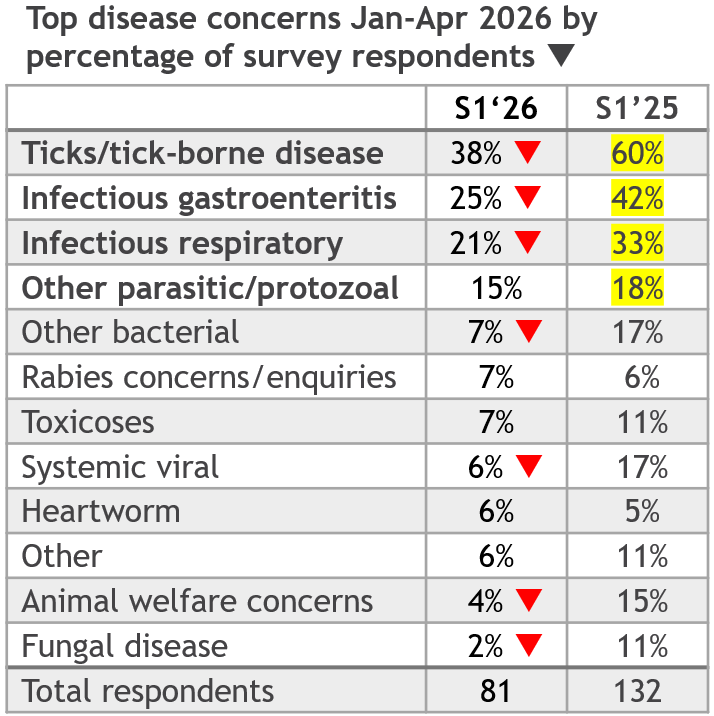 Several respondents commented on seeing more Giardia cases, which contrasts with the decreasing trend in Giardia seen in the Ontario data posted on CAPCvet.org and graphed by OAHN.
Tick “nest” exposures: One survey respondent reported multiple cases of massive nymphal tick infestations (TNTC) in cats over the last couple of years, often in cats that escape outside and hide under a porch or similar. Yuck! Another example of “indoor” pets being more of an aspiration…
As part of the annual OAHN speaker series, Drs. Andrew Peregrine and Scott Weese teamed up for a great webinar “Ontario tick borne diseases to be on the lookout for in 2026 – Lyme is not alone” covering important aspects of Ontario Anaplasma trends and the emergence of Rocky Mountain Spotted Fever (RMSF) in southwestern Ontario. The recording is freely available OANH.ca, along with the other presentations from the series.
Rabies update: Be bat ready, and travel aware!
As the warm weather arrives again, bats remain the highest risk rabies reservoir species in Ontario. It is important to be aware of what bat encounters are (e.g. direct contact with a live bat) and are not (e.g. being in a room with a bat, even asleep) considered a significant risk for rabies transmission, for both people and pets! Check out the latest OAHN veterinary risk assessment guide for bats vs domestic animals as well as all the other tools on the Rabies Resource Page for Veterinarians (OAHN login required).
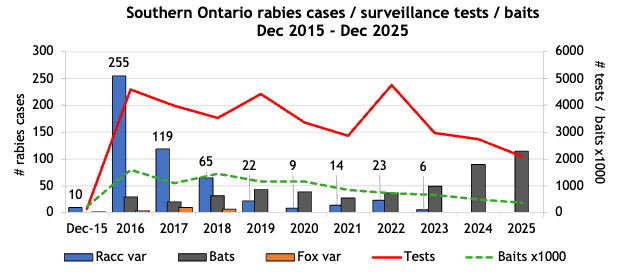
No cases of raccoon variant rabies have been detected in Ontario since 2023, but summer weather means more animal movement, and more potential for translocation of animals by travellers from New York (and other parts of the US) and Southern Quebec, where cases continue to be detected. The Ministry of Natural Resources will shift from control operations to preventative use of their oral rabies vaccine (ORV) baits in key border regions in Niagara and Eastern Ontario in July and August.
It is also important to remain vigilant for fox-variant rabies in the far northern regions of Ontario, as well as dogs that may be translocated from these areas. Canine-variant rabies also remains a risk in dogs imported from (or that have travelled to) high-risk countries. Remember that all dogs, cats and ferrets in Ontario over 3 months of age must be vaccinated for rabies by a veterinarian in Canada or the US, regardless of any other rabies vaccines received overseas. The risk of rabies in dogs from endemic areas (including the far north in Canada) is 6 months from their last potential exposure when they were unvaccinated.
Veterinarians seeking assistance with rabies risk assessments, sample submission and post-exposure management guidance for domestic animals can reach OMAFA via the rabies response request form on the Rabies: Information for Veterinarians webpage.
Keep a lookout! Summer 2026 hazards
Screwworm: Mexico
Valiant efforts continue to be made to keep New World Screwworm out of the southern US, as it creeps ever closer to the Texas border. Although NWS cannot survive in Canada over the winter, during the summer it would be possible for the fly to complete several life cycles and infect local animals (and people). Watch out for suspicious nasty wounds in pets coming from Mexico and areas further south and be aware of potential treatment options. Don’t let those maggots reach the ground! NWS is an immediately notifiable disease in Canada.
Blastomycosis: Increased risk in NY
While blastomyosis is not considered endemic in upstate New York, analysis of 54 laboratory confirmed cases in humans over the past decade suggest the risk is increasing over time. Be aware of the risk in patients travelling to NY, in addition to the “traditional” high risk areas in Ontario (e.g. Northwest, Manitoulin, Ottawa).
RMSF: Long Point ON (and beyond?)
It was at this time last year that the first locally-acquired cases of Rocky Mountain Spotted Fever (RMSF) in Ontario began to appear in dogs and people, associated with travel to Long Point. It remains to be seen if the disease has over-wintered in the same area, or perhaps spread further in the region beyond Long Point itself. Be on the lookout for dogs with compatible signs and travel history, and reach out via the OAHN disease reporting portal or to Dr. Scott Weese if you have a suspicious case. RMSF if not (yet) notifiable in Ontario. There is also an OAHN study underway to test 150 dogs in the Long Point area for antibodies to RMSF to help gauge the level of exposure risk – watch for preliminary results in the next N2K update!
Ticks: BDT and ALHT
In our last OAHN survey, 8/9 respondents who said they had seen Brown Dog ticks (R. sanguineus) in the last two years reported that the dogs had no travel history – weird! Most of these ticks were identified in-house. The Asian Longhorned tick (H. longicornis) has not yet been found in Canada, but continues to spread in the US towards our border. These two ticks can look remarkably similar at a glance! The OAHN team is working on a proposal to collect suspicious ticks for more definitive identification, and possibly future testing. If you find one, hang onto it! (and consider sending a picture to OAHN or etick.ca!)
Anti-parasitics table: 2026 update
One of our most popular resources – the OAHN anti-parasitics table for dogs and cats – has been updated for 2026. Login to OAHN to access the more detailed veterinary version!
Survey: Antibiotic Prescribing Practices
Researchers at the University of Toronto are seeking Canadian companion animal practitioners to participate in an anonymous 10-minute survey on antibiotic prescribing practices with regard to duration of treatment for urinary tract and respiratory infections in dogs and cats. Help guide antimicrobial stewardship efforts and inform future veterinary practice across Canada! The survey is available in English and French.

Antiviral stewardship: FIP drugs
There are many, many happy stories regarding successful treatment of feline infectious peritonitis in cats since effective antiviral drugs became legally available in Canada in 2024. Updated FIP treatment guidelines were recently released by the European Advisory Board on Cat Diseases, and other reviews and guidelines are in development. We also need to make sure we use these drugs appropriately in order to maintain their effectiveness, and avoid using them to try to treat other conditions in cats for which there is little to no evidence.
Help us help you!
Have an idea for an infographic you’d like to see, or a podcast you’d like to hear? Email oahn@uoguelph.ca to let us know!