
OAHN Poultry Expert Network Quarterly Producer Report – Q4 2025
Ontario Animal Health Network (OAHN) Poultry Expert Network Quarterly Producer Report
Immediately Notifiable Hazards Report in Ontario (Jan-Dec 2025)
Information provided by Odebunmi, Bukunmi and Rosca, Lucica- OMAFA
The following should be considered when interpreting laboratory-reported data:
- Submission and detection counts are influenced by multiple factors such as veterinarian producer relationship, diagnostic certainty, disease severity, testing costs, availability of subsidized testing, market value of the animals, and regulatory requirements.
- Reported data include submissions for various purposes including disease monitoring, elimination programs, research and compliance with regulatory requirements.
- Data are reported at the submission level and may represent single or multiple animals and repeat submissions may occur for the same animal(s).
- Counts reflect unique submission IDs. Multiple positive results for the same hazard within a single submission (e.g. PCR and culture) are recorded as one positive submission.
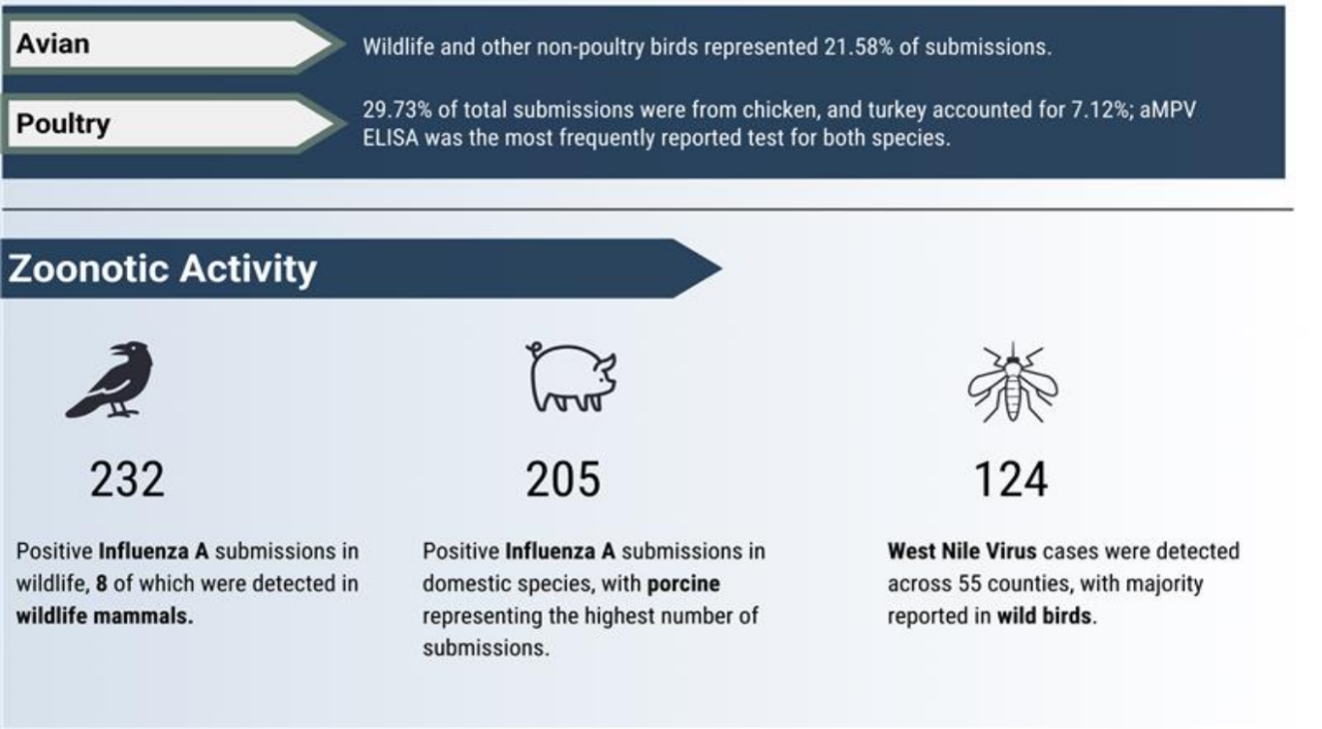
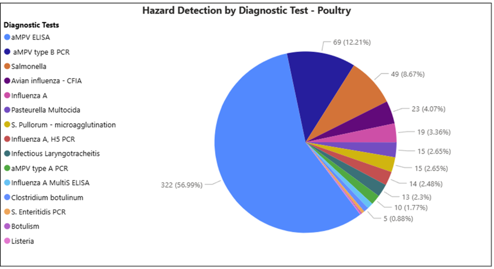
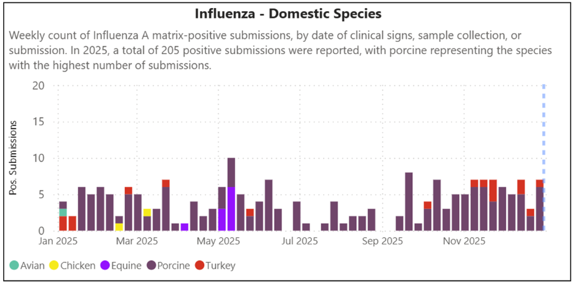
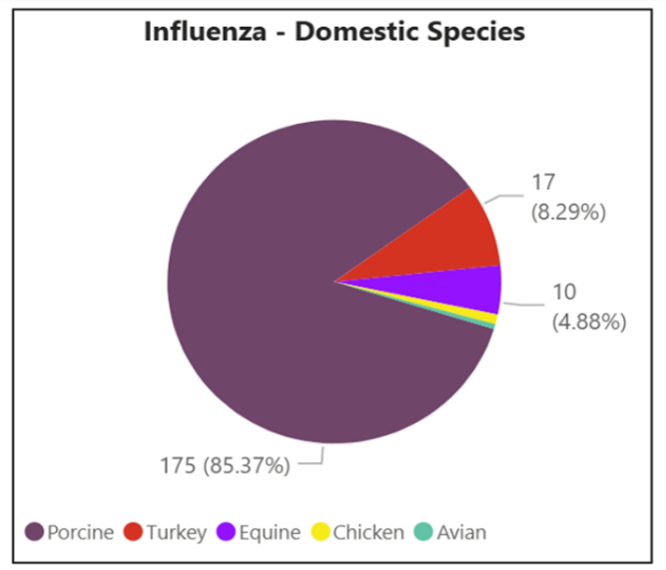
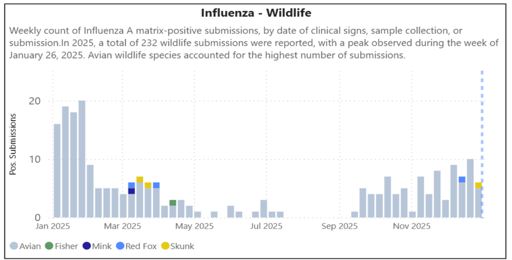
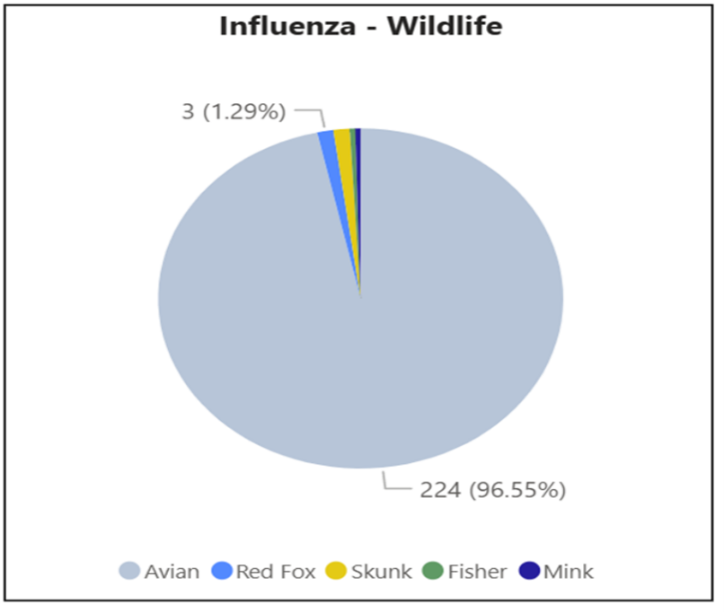
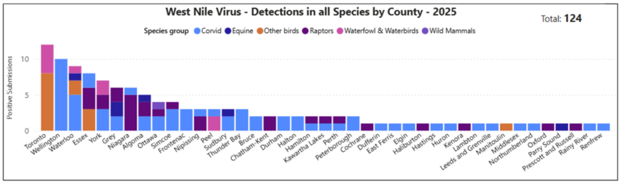
Poultry Veterinarian Survey Highlights – Q4 2025 (Sep-Nov 2025)
Broilers
Most of the conditions were seen stable to slightly increased this quarter.
Practitioners
Stable conditions: ILT, salmonellosis, chicken anemia virus (CAV), other causes of mortality, necrotic enteritis, lameness nutritional and developmental, coccidiosis, ascites, avian metapneumovirus (aMPV), avian influenza, histomoniasis and condemnation issues (cellulitis).
Stable to increased conditions: early and late systemic bacterial infections attributed to E. coli and E. cecorum, lameness of viral origin (reovirus), lameness of bacterial origin (E. coli and E. cecorum) and infectious bronchitis (IBV).
Stable to decreased conditions: inclusion body hepatitis (IBH), infectious bursal disease (IBDV), spiking mortality and runting stunting syndrome (RSS).
A range between 10 to 75% of E. coli isolates were described by practitioners to be resistant to TMS in broilers.
aMPV- lack of clinical signs but serology positive detection and increase in condemnation rate suspected to be attributed to aMPV infections. Identical with the last quarter, practitioners are reporting IBD, IBV and E. coli as the most encountered comorbidities detected in affected flocks.
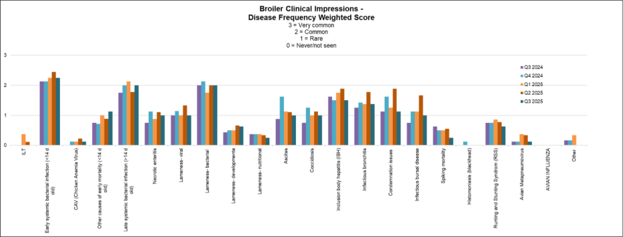
Below graph depicts the frequency of the conditions seen in the flocks. The most frequent 3 conditions seen this quarter were:
Early systemic bacterial infection (<14 d old)
Lameness (Bacterial)
Late systemic bacterial infection (>14 d old)
Similar number of cases (from previous quarter):
– Other causes of early mortality (< 14 days old) – Penetrating foreign body (gizzard) and mycotic pneumonia/airsacculitis.
– Lameness nutritional (rickets).
– Coccidiosis (small intestine, ceca).
– Inclusion body hepatitis (FAdVE/FAdVAC, FAdVD/FAdVAC, FAdVE/FAdVD/FAdVAC, FAdV08b_AHL_16-049095_ON, FAdV08b_AHL_18-057921_ON and FAdV11_USA_1047).
Increased number of cases (from previous quarter):
– Late systemic bacterial infection (> 14 days old) – E. coli and E. cecorum isolated either in pure culture or in combination. E. coli also isolated with P. aeruginosa.
– Lameness viral (Reovirus confirmed: ON_variant_H_18-008168, BC-17-0408-2017, ON_variant_A_12-073195, ON_variant_F_12-087411 and Pennsylvania 13-095523).
– Lameness viral (Reovirus suspicious, primarily diagnosed on histology).
– Infectious bursal disease (PCR positive field strains: USA PA105-2014, British Columbia 15-062782, USA Del-E, USA OH-Sel1-2012 and ON 05-SA08-03-25355. Vaccine strains: UK Faragher52-70 and USA W2512-Blen. Other: USA Edgar).
– Spiking mortality.
Decreased number of cases (from previous quarter):
– Early systemic bacterial infection (< 14 days old) – All cases of septicemia had E. coli isolated either in pure culture or with E. cecorum with or without P. aeruginosa.
– Lameness developmental (tibial dyschondroplasia).
– Lameness bacterial (Primarily diagnosed on histology) – E. coli or E. cecorum isolated either in pure culture or in combination. Also, E. coli and E. cecorum isolated with Staphylococcus hyicus. Two cases of osteomyelitis had E. coli and E. cecorum isolated.
– Infectious bronchitis (IBV – pathology cases and PCR positive) (Field strains: IBV_DMV_ON_21-017385 and IBV_DMV_ON_15-077145. Vaccine strains: IBV_Conn, IBV_Mass-MA5 and USA Mass-AHL 21-008165 vaccine.)
– RSS – Confirmed.
– RSS – Suspect.
No cases diagnosed this quarter:
– Necrotic enteritis.
– Avian metapneumovirus (Type B).
– ILT.
– Dead on arrival (DOA).
Other diagnostic findings:
Proventriculitis, proventricular glandular dilation, ventriculitis, cellulitis, pneumonia (E. coli, E. cecorum), typhlitis (E. coli) and bile duct hyperplasia.
Salmonellosis (clinical)/Salmonella isolation
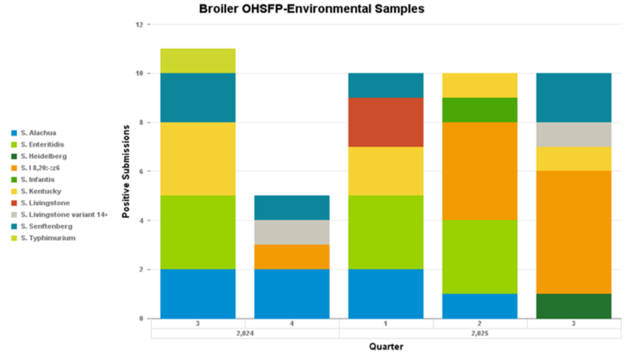
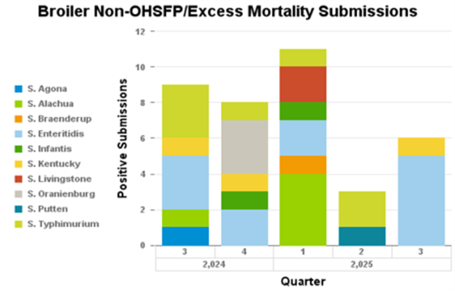
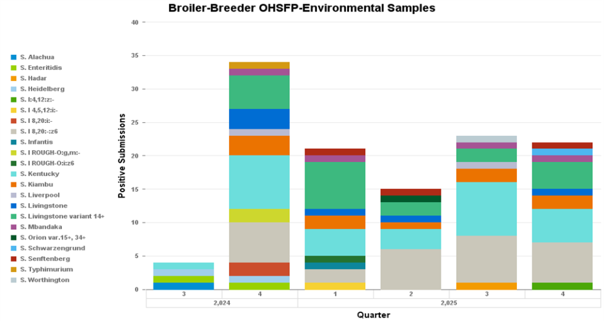
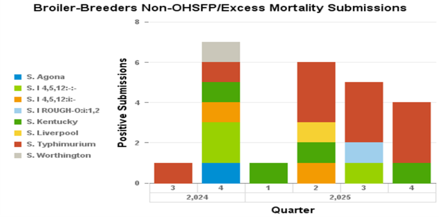
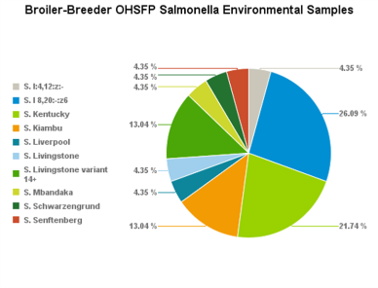
Animal Health Laboratory Salmonella Isolations in Broilers (see graph below summarizing isolations by quarter periods Jan-Mar, Apr-Jun, Jul-Sep, Oct-Dec):
6 positive submissions outside of OHSFP environmental testing (Ontario Hatchery and Supply Flock Program) with 1 S. Kentucky and 5 S.Enteritidis isolated (Graph 2).
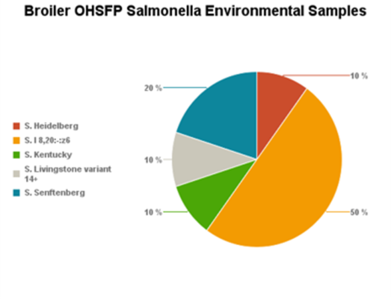
OHSFP environmental samples – S. I 8:20 :-: Z6 and S. Senftenburg were the most isolated (Graph 3 showing Jul-Sep 2025 isolations only).
Slaughter data
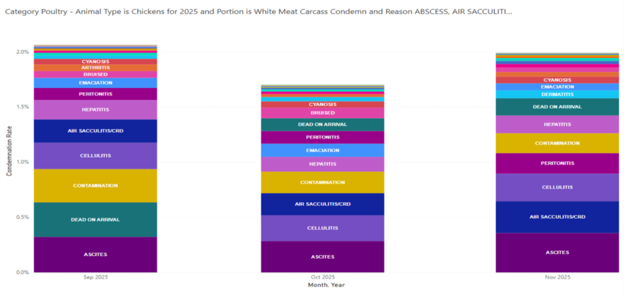
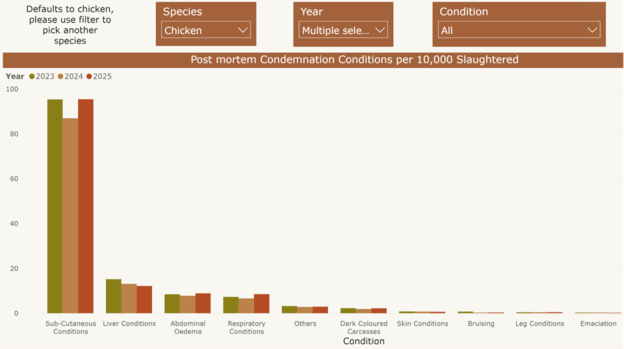
Chickens slaughtered and carcass condemnation (September-November 2025
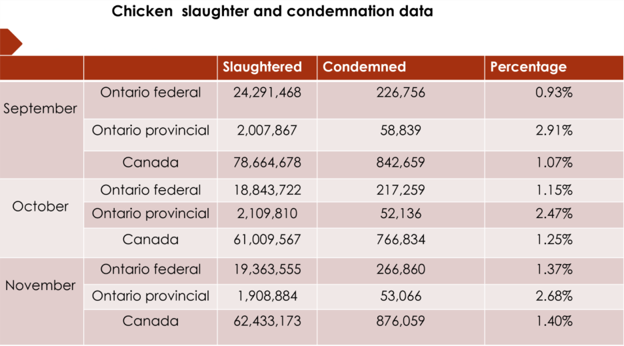
Provincial slaughter: top 3 conditions of condemnation-ascites, cellulitis and air-sacculitis.
Broiler-Breeders
Most of the conditions were reported stable to decreased this quarter with a slight increase in bacterial lameness, early systemic bacterial infections, in-lay bacterial septicemia, and IBV- sudden spike mortality cases.
Early systemic bacterial infections and bacterial lameness were attributed to E. coli, S. aureus, and E. cecorum.
Stable conditions: fowl cholera (isolated bacteria from the joints of vaccinated birds), CAV, other causes of early mortality (<14 days old), lameness developmental/nutritional/ viral, fowl pox, ILT, disease related hatchability issues (aMPV, white chick syndrome), aggression and cannibalism, histomoniasis, pre-lay morbidity/mortality (<20 weeks) and avian influenza. Viral lameness – variant Reovirus isolated from tendons, but no correlation with gross or histological findings.
Stable to slightly increased conditions: early bacterial infections, lameness bacterial, in-lay bacterial septicemia and multi-drug-resistant E. coli (resistant to > 3 drugs).
Stable to decreased conditions: mycoplasmosis, coccidiosis, and necrotic enteritis.
Stable with equally increased or decreased conditions: IBV – decreased production/abnormal eggs, IBV – sudden spike in mortality and aMPV infections. Clinical signs of the latest condition were described by the practitioners as torticollis, swollen heads, uveitis and depression; the most encountered comorbidities were IBV and E. coli septicemic form.
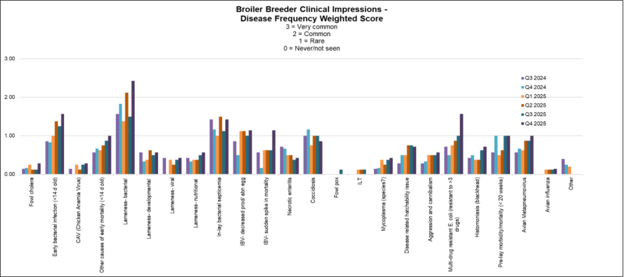
Below graph depicts the frequency of the conditions seen in the flocks. The most frequent conditions seen this quarter were: lameness (bacterial), early bacterial infection (<14 d old) and multi-drug-resistant E. coli (>3 drugs).
Fowl cholera (Pasteurella multocida) – Occasionally isolated from lameness cases from vaccinated flocks.
Similar number of cases (from previous quarter):
– Bacterial pneumonia – E. coli, E. cecorum and G. anatis isolated together.
– Avian metapneumovirus (Type B). Concurrent infections included bacterial osteomyelitis (E. coli, E. cecorum), meningitis and otitis interna (E. coli, P. multocida).
– Lameness developmental – Slipped tendon and peritendinous hemorrhage.
– Pododermatitis – E. cecorum isolated in pure culture or with Avibacterium spp.
– Other causes of inlay mortality – Liver hemorrhage and ascites/right ventricular dilation.
Increased number of cases (from previous quarter):
– Early bacterial infection (<14 days old) – Cases of septicemia had E. coli isolated in pure culture or in combination with E. cecorum, P. aeruginosa or S. aureus.
– Other causes of mortality (> 14 days old) – dehydration, bacterial meningitis and renal tubular necrosis.
– Lameness viral – Reovirus. One case identified in through the virology lab (ON_variant_H_18-008168).
– Amyloidosis.
Decreased number of cases (from previous quarter):
– Prelay morbidity/mortality (<20 weeks) – S. aureus isolated in pure culture. E. coli and E. cecorum were isolated together as well as in combination with S. aureus. Other diagnoses included emaciation, hepatitis, rhinitis as well as bursal and thymic atrophy.
Additionally, 1 strain of CAV (CAV_ON_AHL14-051493-0003) and 2 strains of IBDV (USA Del-E, USA GA-1) were identified in this age group.
– Inlay bacterial septicemia – E. coli, S. aureus and E. cecorum were each isolated in pure culture. E. coli and S. aureus were isolated together. E. coli and E. cecorum were isolated together as well as in combination with C. septicum. Finally, E. coli, G. anatis and C. septicum were isolated together.
– Cellulitis/Dermatitis – Breast blister (S. aureus and S. hyicus).
– Lameness trauma – Tendon rupture, keel bone fracture with liver hemorrhage and tibiotarsal bone fracture (hemorrhage into surrounding muscle and subcutaneous tissues).
– Lameness bacterial – S. aureus and E. coli were each isolated in pure culture. S. aureus and E. coli were isolated together, with or without S. hyicus. E. coli and E. cecorum were also isolated together, with or without S. aureus. S. aureus was also isolated with E. cecorum. Cases of vertebral osteomyelitis had E. cecorum isolated in pure culture or with E. coli. There were also multiple cases of femoral head necrosis (no culture).
– Coccidiosis – Identified in the small intestines, ceca or both (E. acervulina, E. tenella).
– Intestinal parasitism – Histomonas.
– IBV (decreased productivity/abnormal eggs/sudden spike in mortality) – (IBV_DMV_ON_21-017385).
– White Chick Syndrome.
No cases diagnosed this quarter:
– Lameness nutritional (rickets).
– Necrotic enteritis (C. perfringens isolated).
– Fowl pox.
– Mycoplasmosis.
– Urate nephrosis/visceral urates/articular urates.
Layers
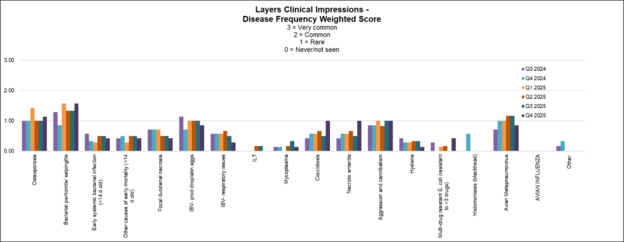
Veterinarians are reporting a change in health status of the flocks since September 2025, with increasing cases of peritonitis/salpingitis, bronchitis and aMPV, but also coccidiosis and necrotic enteritis. It is hypothesized that this shift is related to changes implemented 6 months ago in birds’ density population due to increasing in eggs demands; this practice stopped as of January 1st, 2026.
Practitioners
Stable conditions: osteoporosis, early systemic bacterial infection, other causes of mortality (fecal impaction), focal duodenal necrosis, IBV respiratory issues, ILT, mycoplasmosis, hysteria, multi drug resistant E. coli (resistant to > 3 drugs), histomoniasis and avian influenza.
Stable to increased conditions: bacterial peritonitis/salpingitis early in the lay period (E. coli), IBV production drop/abnormal eggs, coccidiosis (E. tenella), necrotic enteritis, aggression and cannibalism, and aMPV.
Comorbidities involved with aMPV detected cases: egg drop production and lack of peak production, uneven pullet size, E. coli septicemia and IBV. Layer flocks are now aMPV vaccinated and estimated time to see benefits on implementing aMPV vaccination is middle of 2027.
Below graph depicts the frequency of the conditions seen in the flocks. The most frequent conditions seen this quarter were: bacterial peritonitis/ salpingitis, osteoporosis, coccidiosis, necrotic enteritis, aMPV; IBV- prod drop/abnormal eggs; aggression and cannibalism.
Similar number of cases (from previous quarter):
– Necrotic enteritis (C. perfringens).
– Coccidiosis (Small intestine).
Increased number of cases (from previous quarter):
– Early mortality (other) – Yolk sacculitis, peritonitis as well as bursal and thymic atrophy.
– Prelay mortality (<20 weeks old) – Septicemia, salpingitis, bursal atrophy and tracheitis / sinusitis.
– Infectious bronchitis (IBV – production drop/egg abnormalities/ respiratory) – Field strains: IBV_DMV_ON_21-017385 and IBV_CA_1734_04_ON_12-025379. Vaccine strains: IBV_Mass-MA5 vaccine.
Decreased number of cases (from previous quarter):
– In-lay mortality (>20 weeks old) – Septicemia (E. coli).
No cases diagnosed this quarter:
– Early mortality (<14 days old, starve outs).
– Early mortality (<14 days old, omphalitis).
– Osteoporosis.
– Leg issues – Trauma, bone fracture.
– Leg issues – Bacterial (tenosynovitis).
– Leg issues (other).
– Focal duodenal necrosis (FDN).
– Intestinal parasitism (other).
– Avian metapneumovirus.
– Aggression/Hysteria.
– Mycoplasma.
– Elevated DOA.
Other diagnostic findings:
Neoplasia, lymphoid neoplasia, salpingitis, liver fracture, splenomegaly, granulomatous cellulitis / myositis, myopathy, osteomalacia, peritonitis / oophoritis, vaccine reaction, proventricular glandular degeneration / hemorrhage and comb thrombosis / necrosis.
Salmonellosis (Salmonella isolation)
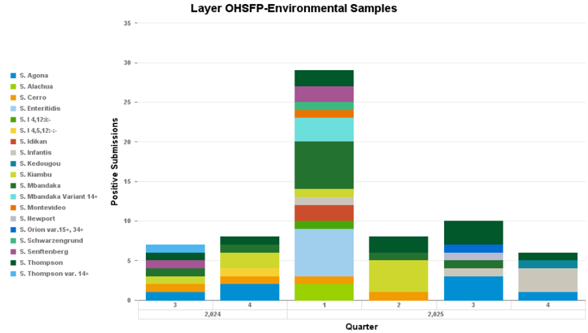
Animal Health Laboratory Salmonella Isolations in Layers (see graph 1 below summarizing isolations by quarter periods Jan-Mar, Apr-Jun, Jul-Sep, Oct-Dec):
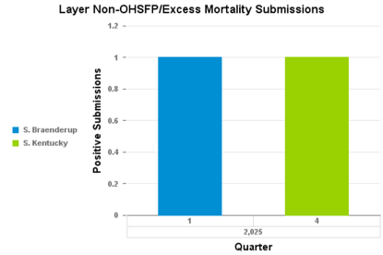
There was 1 positive submission outside of OHSFP environmental testing this quarter; S. Kentucky was isolated (Graph 2).
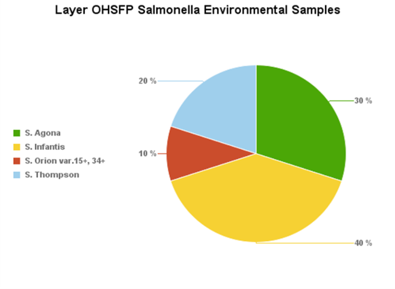
From September 1st to November 30th AHL tested 278 OHSFP environmental submissions and 1,449 samples – S. Agona and S. Infantis were the most isolated (Graph 3 showing Sep-Nov 2025 isolations only).
Turkeys
Practitioners
Turkey flock health conditions were mostly stable this quarter. aMPV infections continue to be detected in the flocks and type A detection was mostly attributed to vaccination.
Stable conditions: fowl cholera, erysipelas, early systemic bacterial infection (E. coli), other causes of mortality, mycotic respiratory disease, necrotic enteritis, enteritis, coccidiosis, reovirus tenosynovitis, round heart, multi drug resistant E. coli (resistant to > 3 drugs), histomoniasis (one case with elevated rate of mortality), avian influenza, aggression and cannibalism.
Stable to slightly increased conditions: late systemic bacterial infection (E. coli), mycoplasmosis (M. synoviae and M. gallisepticum), other respiratory diseases (bacterial infections and aMPV).
Comorbidities identified with aMPV infected flocks were bacterial infections (E. coli) presented as septicemia/airsacculitis/bacterial pneumonia, crop mycosis, and acute mortality with swollen head.
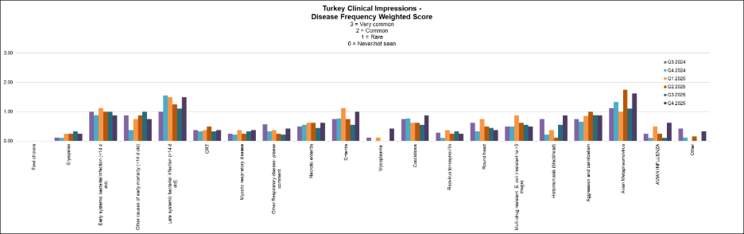
Below graph depicts the frequency of the conditions seen in the flocks. The most frequent 3 conditions seen this quarter were: aMPV, late systemic bacterial infection (>14 d old) and enteritis.
Similar number of cases (from previous quarter):
– Histomoniasis.
– Tibial dyschondroplasia.
Increased number of cases (from previous quarter):
– Early systemic bacterial infection (<14 days old) – E. coli in pure culture.
– Late systemic bacterial infection (>14 d old) – E. coli isolated in pure culture or in combination with P. aeruginosa.
– Bacterial pneumonia – Pneumonia and pleuritis.
– Reovirus – Avian orthoreovirus.
Decreased number of cases (from previous quarter):
– Avian metapneumovirus – Type B (Type B Turkey ON 24-093127-0001) and Type A.
– Coccidiosis/ Parasitism – Small intestine.
No cases diagnosed this quarter:
– Fowl cholera (Pasteurella multocida).
– Erysipelas.
– Other causes of early mortality (<14 days old, starve out / dehydration).
– ORT (Ornithobacterium rhinotracheale).
– Mycotic respiratory disease.
– Enteric disease.
– Necrotic enteritis.
– Rickets.
– Condemnations.
– DOA.
– Mycoplasma.
Other diagnostic findings:
Avian Influenza, dermatitis/cellulitis, typhlitis/cecal cores, hepatic interstitial fibrosis, ventriculitis, proventriculitis, skeletal muscle necrosis and salpingitis.
Salmonellosis (Salmonella isolation)
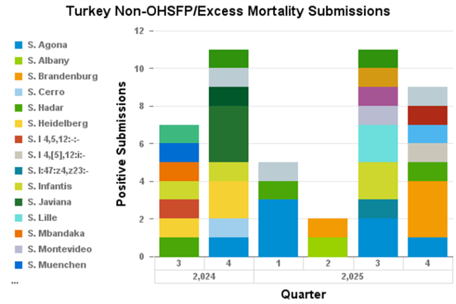
Animal Health Laboratory Salmonella Isolations in Turkeys (see Graph 1 below summarizing isolations by quarter periods Jan-Mar, Apr-Jun, Jul-Sep, Oct-Dec):
10 positive submissions outside of OHSFP environmental testing with 3 S. Brandenburg, 1 S. Infantis, 1 S. Senftenburg, 1 S. Agona, 1 S. Hadar, 1 S. I 4, [5], 12:i-, 1 S. Typhimurium and 1 S.Schwarzengrund isolated (Graph 2).
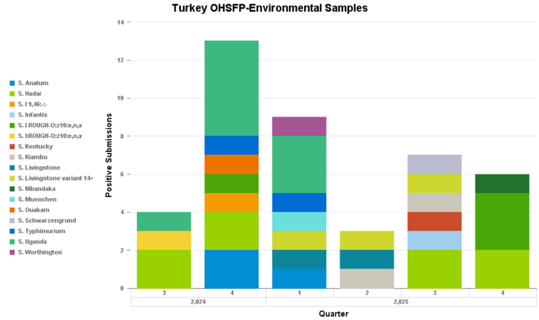
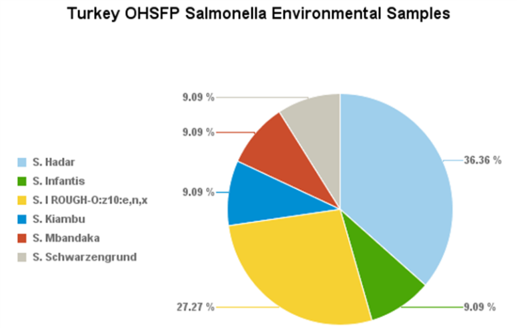
From September 1st to November 30th AHL tested 354 OHSFP environmental submissions and 1,731 samples. OHSFP environmental samples – S. Hadar and S. I Rough-O:z10e,n,x were most isolated (Graph 3 showing Sep-Nov 2025 isolations only).
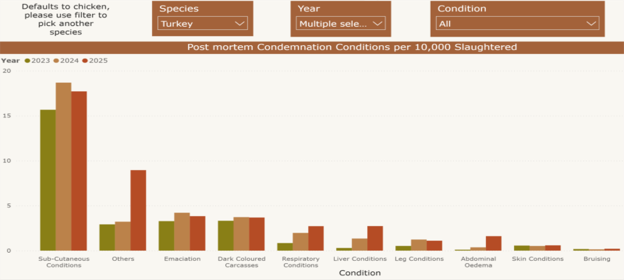
Slaughter data (September-November 2025)
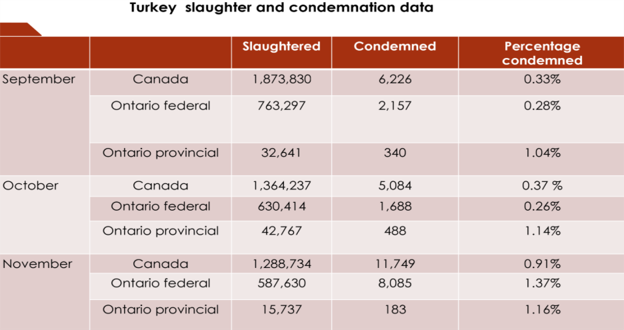
Provincial slaughter– top 3 main conditions listed for this quarter were: ascites, cellulitis and airsacculitis.
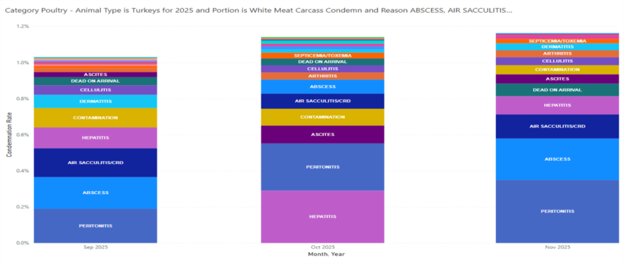
Top 3 main conditions listed for this quarter were: subcutaneous, others and emaciation
Small Flock
Chickens:
AHL: Diagnoses at AHL included mites (Knemidocoptes), intestinal parasitism (coccidiosis, nematodes, protozoa), Marek’s disease, neoplasia (adenocarcinoma/carcinomatosis), peritonitis/salpingitis (including E.coli), bacterial septicemia (E.cecorum, E.coli, Listeria monocytogenes), pneumonia/airsacculitis (aspergillosis, mycotic tracheitis, airsacculitis), urate nephrosis, ascites, complex respiratory disease (M.gallisepticum, IBV), and other (sinusitis – Avibacterium spp. / E.coli / E.cecorum, dehydration, emaciation, E.coli arthritis, gizzard erosion and hemorrhage, yolk sacculitis, egg bound, skin ulcers – E.coli / E.faecalis / K.pneumoniae, reovirus).
ILT: 3 cases (1 Niagara-like strain CAGG cluster).
Gamebird:
AHL: One peafowl and one quail case submitted this quarter. One pheasant case (virology data).
Quail:
1) Emaciation, dehydration
Pheasant:
2) Avian metapneumovirus Type B Turkey ON 24-093127-0001
Peafowl:
1) ILT (CEO/TCO vaccine-like strain TCAA cluster)
Waterfowl:
AHL: Four duck and 1 goose cases submitted this quarter.
Ducks:
1) Pekin duck – E.coli septicemia at hatch.
2) Pekin duck – hepatic lipidosis, suspect septicemia.
3) Duck – E. coli septicemia, nematodes, esophageal ulceration.
4) Duck – necrotizing typhlitis.
5) Canada goose – poor feathering, folliculitis.
Turkey:
AHL: One turkey case submitted this quarter.
1) Gastric foreign material, lice, GI parasitism (Eimeria, Heterakis), bursal atrophy.
Practitioners: Information provided with the clinical impression in chickens and waterfowl.
Frequency of conditions seen in practice:
Common: Trauma.
Rare: Vent trauma, ascites and other (osteoarthritis).
Not seen: Ectoparasitism, intestinal parasitism, Marek’s disease, other neoplasia, GI impaction, pododermatitis, peritonitis/salpingitis, bacterial septicemia, pneumonia/airsacculitis, FLHS, urate nephrosis/ visceral urates/articular urate deposits, ILT, histomoniasis, erysipelas, toxins, Mycoplasma, and aMPV.
Changes since last quarter: Stable conditions: Marek’s disease, GI impaction, trauma, peritonitis/salpingitis. Increased cases: vent trauma, other (osteoarthritis). Decreased cases: ectoparasitism, intestinal parasitism, other neoplasia, pododermatitis.
Poultry research from Ontario and beyond
- Biosecurity investment impacts on highly pathogenic avian influenza control in United States commercial turkey operations – ScienceDirect
- Layers Laying Broilers (LLB) Project – NextHen
- Rickets and Metastatic Mineralization in Broilers Associated with Excess Dietary Calcium and Phosphorous | Avian Diseases
- Trends in Necrotic Enteritis and Coccidiosis Control Practices in Canadian Poultry Flocks, 2018–2023 | Avian Diseases
Events and News
Poultry Industry Council events: https://www.poultryindustrycouncil.ca/events Poultry Health Research Network information, events, and lectures can be accessed on the PHRN website: https://phrn.net/ or on the PHRN YouTube channel: https://www.youtube.com/user/PoultryHRN
Thank You! We thank the following poultry veterinarians who completed the veterinary survey:
Dr. Tim Abolarin, Dr. Elizabeth Black, Dr. Joanne Dias, Dr. Daniella Di Pirro, Dr. Fernando Salgado-Bierman, Dr. Shahbaz Haq, Dr. Elana Huong, Dr. Anastasia Novy, Dr. Mike Petrik, Dr. Joanne Rafuse, Dr. Nahal Ramezani, Dr. Ben Schlegel, Dr. Chanelle Taylor, Dr. Brenna Tuer, Dr. Alex Weisz, and Dr. Jessalyn Walkey. Small Flock: Dr. Amari Patel.