Swine Industry Report – Q2 2026
Ontario Animal Health Network (OAHN) Swine Network Quarterly Industry Report
Porcine Epidemic Diarrhea Virus (PED) and Porcine Deltacoronavirus (PDCoV) Ontario Update
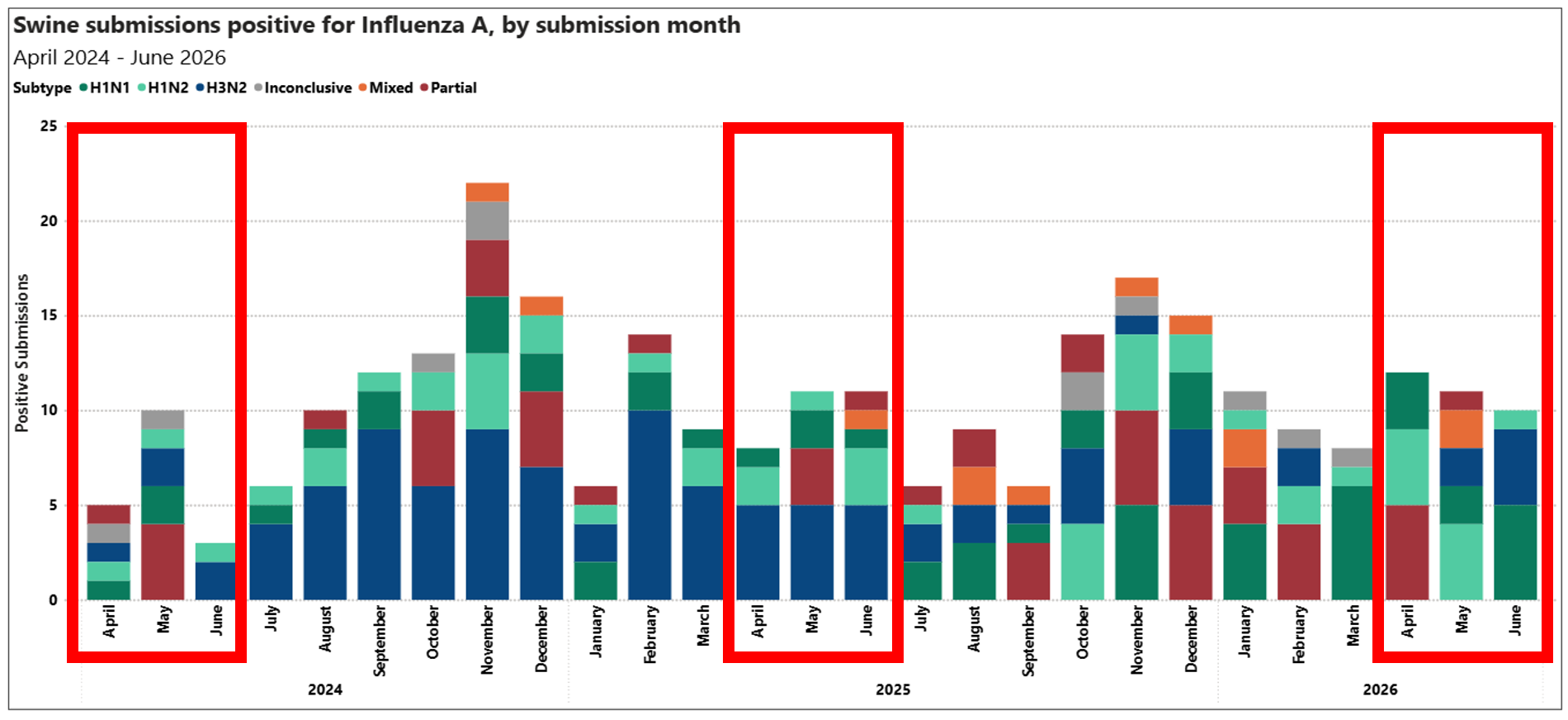
Jessica Fox from Swine Health Ontario (SHO) provided an update on PED and PDCoV cases in Ontario for Q2 of 2026. New positive cases of PED and PDCoV dramatically dropped off after March, with only 10 cases of PED and no new PDCoV cases. Of these new positive PED cases, the affected herds included 1 farrow to finish site, 1 farrow to wean site, 3 nurseries, 5 finishers, and 1 gilt breeding barn. In previous years, following a large winter outbreak, there has been a secondary spike in the spring as a result of PED-positive manure being spread. This was not seen this year, which Jessica attributes to producers being extremely mindful about manure movements and barn biosecurity.
Jessica also provided an update on the SHO PED working group, which has been meeting regularly over the past months to strategize on how to reduce provincial PED and PDCoV cases in the future. SHO will be holding producer meetings in the early fall to continue communication and information sharing with the industry, specifically producers, ahead of the cold weather. The goal of these meetings is to continue to keep the PED, and PDCoV risk factors top of mind as the winter season approaches, in hopes that producers will be prepared ahead of the usual PED season to reduce the total number of new positive cases. SHO will be providing more details about these meetings in the coming weeks.
Influenza A (IAV) in Swine
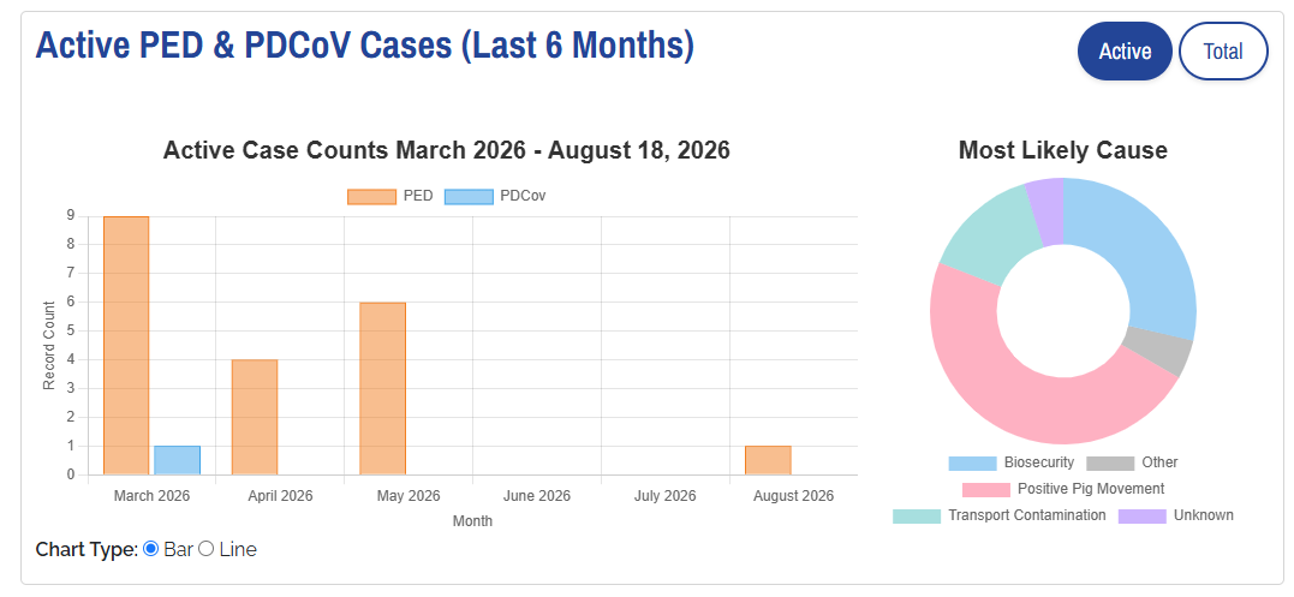
During Q2 of 2026, there were 32 positive submissions. This is similar to Q2 of 2025, with 30 positive submissions, but higher than Q2 of 2024 with 18 positive submissions. During Q2 of this year, positive submissions were primarily of the H1N1 subtype (31%), followed by H1N2 (28%). This quarter, the majority of positive submissions were from the grow-finish stage of production. Most of the H1N1 isolations this quarter were of the pandemic clade, and the majority of the H1N2 submissions were of the alpha clade.
OAHN Projects- Now Accepting Samples!
Dr. Rebecca Egan provided an update on the current OAHN swine projects. Reminder project #1 on PCV-2 and project #2 on Sapovirus are both open and accepting samples! Please consider both when completing herd visits and/or performing PM exams. Both projects will be running until December 2027 or until sample quotas are met, so practitioners are encouraged to participate when they have eligible cases.
Project #1- This project aims to assess Porcine Circovirus type 2 (PCV-2) prevalence in the Ontario herd, specifically with respect to the different PCV-2 subtypes. PCV-2 PCR-positive samples submitted to AHL are eligible, and this project will sequence these samples to determine subtype. These results will allow for better understanding of the distribution of different PCV-2 subtypes within the province. A short survey will accompany these submissions to better understand the clinical picture of each case. To date, 40 cases have been tested for PCV-2 under this project. PCV-2d was identified in 19 cases (47.5%), making it the predominant genotype. PCV-2a was detected in eight (20%) cases. Eleven cases (27.5%) were untypable, most commonly due to concurrent detection of PCV-1, which interfered with sequencing and typing. One result is still pending.
Project #2- This project focuses on the neonatal diarrhea complex and the role of Sapovirus in these cases. Eligible cases will be those with piglets less than 20d of age presenting with a clinical scour and an accompanying Sapovirus PCR-positive result. A specific AHL submission form and samples (3 fecal samples PER PIG) are required for enrollment in this project, in addition to completion of a short survey by the submitting veterinarian. Links to the submission form and vet survey can be found on the OAHN swine website. This project aims to provide a better understanding of how Sapovirus contributes to neonatal diarrhea cases, especially amongst other common pathogens. A total of 15 cases have been submitted to the Porcine Sapovirus project. Of these submissions, seven (46.7%) have tested positive for Sapovirus, all of which also tested positive for Rotavirus. Sapovirus ISH is pending to evaluate for presence and distribution of viral antigen within the intestinal lesions.
There are still submissions needed for this project, so if you have a case that fits the above description, please consider submitting. The study will cover all testing, totaling roughly $300-400 per pig! Any questions can be directed to Dr. Rebecca Egan eganr@uoguelph.ca.
Senecavirus A (SVA) Ontario Update
Jessica Fox from SHO provided an update on Senecavirus A (SVA) in Ontario for Q2 of 2026. The SVA surveillance project is currently underway. A total of 13 cases have been passively tested for SVA, all of which have tested negative. Cases are passively selected at AHL for testing if they follow the established criteria of scour cases in piglets 8 weeks and younger.
SHO and OAHN would like to encourage practitioners and producers to continue to monitor herds for clinical signs, as these can be extremely subtle. Older pigs tend to present with vesicular lesions on the snout and/or coronary band(s). In a sow barn, infections can present as a very subtle scour. (Source Poster below: Swine Health Ontario).
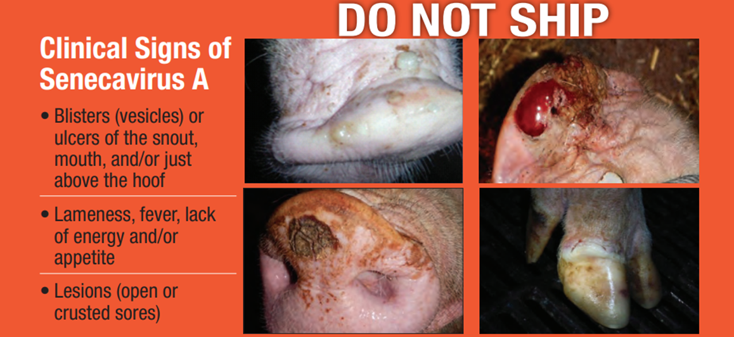
Producers and veterinarians in all provinces need to understand that SVA lesions can be mild and hard to notice in some animals. Diligence is required to check all animals for SVA type lesions including blisters, ulcers on the snout, ears, face, on the coronary band or between the claws on the feet before shipping them for slaughter, cull markets and/or directly for export to the USA. If a swine producer has any suspicion that there may be SVA in a swine herd, they are urged to contact their vet and the CFIA for follow-up steps!
Wild Pigs Removed from Ontario Landscape
During Q2 of 2026, the Ministry of Natural Resources (MNR) confirmed that three wild pigs were removed from the landscape in Ontario. Samples from all three pigs were submitted to laboratories under the CanSpotASF surveillance testing program and were confirmed negative for ASF.
The first pig removed had unknown origins about where it originated, and how long it had been on the landscape for. It was reported that this pig had been harassing a farmer’s cattle.
The second removal was of a Eurasian wild boar, which was found dead, and was believed to be a possible roadkill. Reports suggest that this may have been the final member of a group of wild boar from the Hawkesbury region that were first sighted in March 2024. If this is confirmed to be the final member of that group, this pig had been wild and on the landscape for several years.
The third wild pig removed was a domestic breed in the Sauble area, and reports suggest that it had been on the landscape for a few weeks.
International Disease Topics Of Interest Summary
Pathogen Surveillance in Invasive Wild Pigs in Alberta
Wild pigs have become established across the Canadian prairie provinces following escapes and releases from wild boar farms, raising concern about their role as reservoirs for livestock pathogens. Alberta markets more than 2.87 million pigs annually, and 74.5% of the province’s 1,100 pig-holding operations are smallholder or backyard farms, which may create more opportunity for contact between wild and domestic pigs. This study provides the first overview of production-limiting and zoonotic pathogens circulating in Alberta’s invasive wild pig population.
Between 2018 and 2024, 331 wild pigs were captured through the Alberta Wild Boar Control Program using whole-sounder trapping and tested for 17 pathogens by serology, bacteriology, coprology and PCR. Antibodies to Erysipelothrix rhusiopathiae were found in all 120 serum samples tested (100%), with porcine circovirus 2 (PCV-2) in 31.7%, Mycoplasma hyopneumoniae in 2.1% and PRRSV type 1 in 1.0%. By PCR, PCV-2 was detected in 32.9%, PCV-3 in 27.2%, rotavirus A in 22.8%, porcine parvovirus in 17.8%, rotavirus C in 5.4% and PCV-1 in 0.3%. Two of 72 pigs yielded Salmonella enterica, one serotype Montevideo and one subspecies diarizonae. Porcine deltacoronavirus, porcine epidemic diarrhea virus, transmissible gastroenteritis virus, Seneca Valley virus, influenza A virus and rotavirus B were not detected in any animal. Gastrointestinal and respiratory parasites were common, with Eimeria spp. in 39.6% and Metastrongylus spp. in 25.5%.
Mature animals were at significantly higher risk of PCV-2 and PCV-3 detection, and co-detection of two or more pathogens occurred in 55.9% of the 68 animals with complete results, with a significant positive association between PCV-2 and PCV-3.
The authors conclude that wild pigs in Alberta harbour pathogens significant to both pork production and public health, demonstrating potential transmission risk at the wild-domestic pig interface and supporting continued surveillance from a One Health perspective.
Ley-Garcia, O., Mainali, C., van der Meer, F., Ojkic, D., Malgarin, C., Turk, B., Checkley, S. L., McKenzie, H., & Pruvot, M. (2026). Surveillance of zoonotic and production-limiting pathogens in invasive free-ranging wild pigs in Alberta, Canada. BMC Veterinary Research. Published online August 5, 2026. https://doi.org/10.1186/s12917-026-05793-1
African Swine Fever
First-Ever Detections: Finland and Hungary
Finland confirmed its first-ever ASF detection on July 31, in three wild boar piglets found dead in Virolahti, near the Russian border. A restricted zone with a 3-km core zone, movement restrictions, suspension of hunting and mandatory testing of wild boar were introduced. Taiwan removed Finland from its ASF-free list, and exports to Japan, China, Singapore and Taiwan were suspended; Finland exports approximately USD 85 million of pork annually outside the EU. Hungary confirmed its first-ever outbreak in domestic pigs on June 3 at a commercial farm housing 3,166 pigs, approximately 1 km from the Romanian border, following eight years of circulation in wild boar. Italy reported its first domestic outbreak in Tuscany on June 26, and Ukraine its first in more than 17 months on May 19.
Europe: Domestic Pig Outbreaks Climb While Wild Boar Cases Fall
Between April and July 2026, ASF outbreaks in domestic pigs in Europe rose each month, from 19 in April to 37 in May, 164 in June and 186 in July, while outbreaks in wild boar fell from 987 to 804, 661 and 396.
Perez, M. S., Yustyniuk, V., Ochwo, S., Schulte, R., Neuser, S., & Ondieki, G. (2026). Swine Disease Global Surveillance Report, May 5, 2026 – June 2, 2026. Swine Health Information Center & Center for Animal Health and Food Safety, University of Minnesota. https://www.cahfs.umn.edu; Perez, M. S., Yustyniuk, V., Ochwo, S., Schulte, R., Neuser, S., & Ondieki, G. (2026). Swine Disease Global Surveillance Report, June 3, 2026 – July 7, 2026. Swine Health Information Center & Center for Animal Health and Food Safety, University of Minnesota. https://www.cahfs.umn.edu; Perez, M. S., Yustyniuk, V., Ochwo, S., Neuser, S., Ondieki, G., Meneses Hernandez, T. T., & Patterson, A. (2026). Swine Disease Global Surveillance Report, July 7, 2026 – August 3, 2026. Swine Health Information Center & Center for Animal Health and Food Safety, University of Minnesota. https://www.cahfs.umn.edu.
How can you Participate in OAHN?
Share the information contained within this report with others involved in the swine industry and with other swine producers. Help us spread the word!
Ask your veterinarian for more information about topics included in this report.