

OAHN Companion Animal Project: Surveillance of Rhipicephalus spp. and Haemaphysalis longicornis in dogs in Ontario (in progress)

Project Lead: Dr. Katie Clow (OVC)
Collaborators: Dr. Maureen Anderson, Dr. Emma Webster
Rationale
Brown dog ticks (Rhipicephalus spp.) are common parasites of dogs in warm temperate and tropical regions. They can form heavy infestations and pose a health risk due to high levels of parasitism and/or pathogen transmission. These pathogens include Rickettsia conorii and R. rickettsii, the causative agents of Mediterranean spotted fever and Rocky Mountain spotted fever, respectively, and Ehrlichia canis, the causative agent of canine ehrlichiosis. Brown dog ticks can also bite humans, albeit less commonly, and transmit pathogens of human health concern (e.g., R. conorii and R. rickettsii).1,2
Reports of dogs bitten by brown dog ticks in Canada are typically linked with either recent importation or travel with owners from endemic regions.3,4 Sustained local reproduction is unlikely in Canada given its cooler climate. However, given this tick’s ability to thrive indoors, indoor infestations have been reported following introduction and thus provide an opportunity for local acquisition depending on if dogs frequent that indoor environment (e.g., boarding kennels, veterinary clinics, grooming facilities).1,2
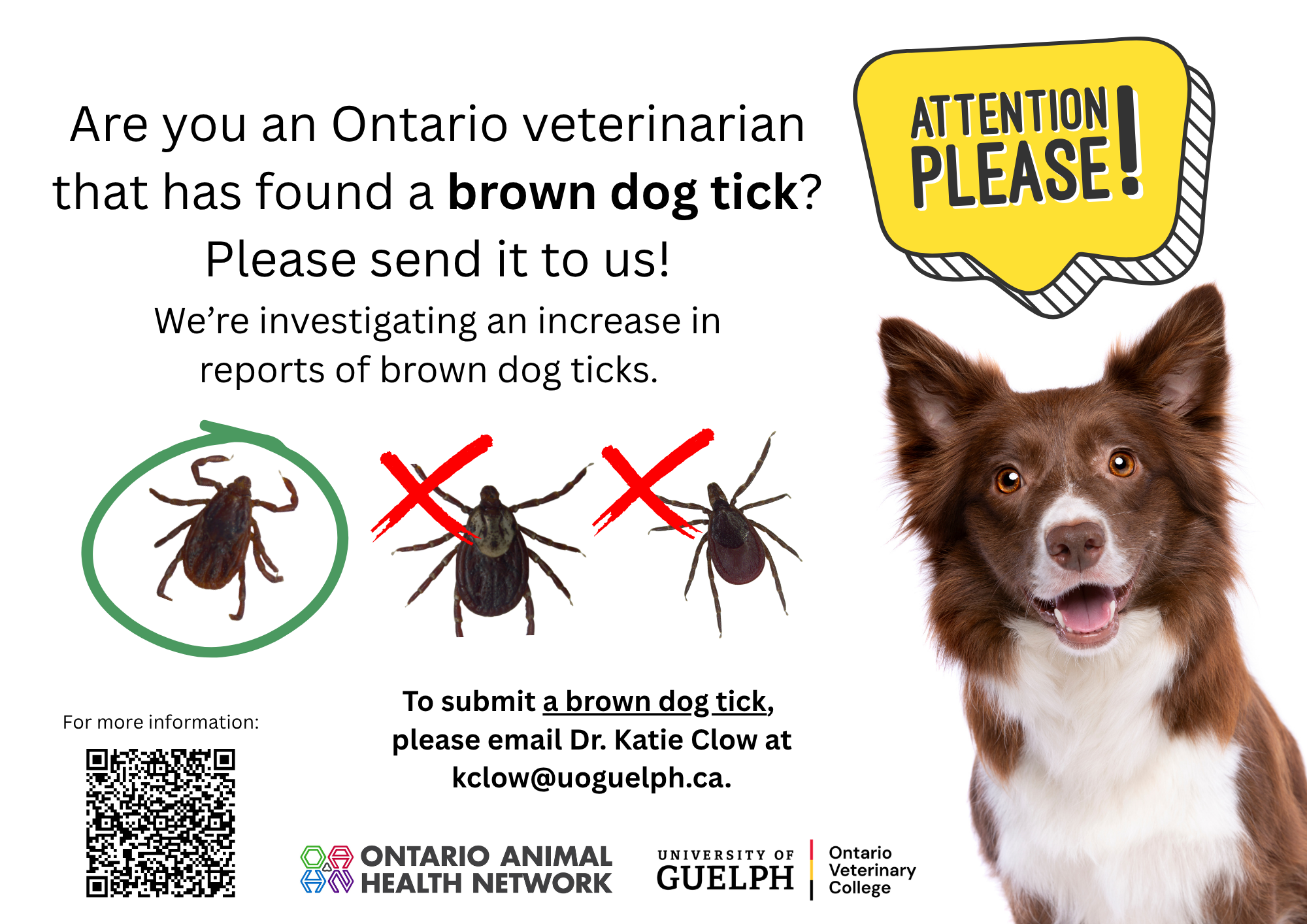
Basic morphological identification to genus level can be completed using a stereomicroscope and standard identification keys.5 A characteristic feature of the Rhipicephalus genus is a hexagonal basis capituli (the structure that connects the mouthparts of the tick to the body).5 This gives the head (mouthparts and basis capituli) of the tick a triangular appearance. However, individuals who do not complete tick identification on a regular basis can confuse this triangular head appearance with that of the Haemaphysalis genus, which have angled mouthparts and a rectangular basis capituli.5 Anecdotally, it is also not uncommon to hear veterinarians call the commonly encountered American dog tick (Dermacentor variabilis) brown dog ticks because the names are similar, and American dog ticks are brown.
There has been an ‘uptick’ in veterinary reports of brown dog ticks in recent OAHN quarterly reports. These reports have been from dogs across numerous locations in Ontario with no known out of country travel history. All identifications have been completed in-house by veterinary clinic personnel. It is unknown if these identifications are correct. If these are truly reports of brown dog ticks, further epidemiological investigation is warranted to determine exposure source and potential pathogen transmission risks. If identification is incorrect, it is critical to assess if these could be misidentified Haemaphysalis spp. There are native Haemaphysalis spp. in Ontario, but these ticks rarely parasitize dogs.5 On the other hand, Haemaphysalis longicornus, is an invasive tick species not yet detected in Ontario and has been reported frequently on dogs.6,7
Objectives
1. Validate the signal generated by OAHN companion animal quarterly survey regarding a change in exposure to tick species in Ontario.
2. Evaluate the potential risk factors associated with change in exposure.
Get Involved
If you have identified a brown dog tick, please contact Dr. Katie Clow at kclow@uoguelph.ca to submit your tick. Shipment costs are covered.
References
1. Dantas-Torres, F. Biology and ecology of the brown dog tick, Rhipicephalus sanguineus. Parasit. Vectors 3, 1–11 (2010).
2. Dantas-Torres, F. & Otranto, D. Rhipicephalus sanguineus (Brown dog tick). Trends Parasitol. 38, 993–994 (2022).
3. Myers, S., Clow, K., DeWinter, S., Sundstrom, K. & Little, S. Multiple species of canine Rhipicephalus complex detected in Canada. Vet. Parasitol. Reg. Stud. Rep. 48, 100976 (2024).
4. DeWinter, S., Bauman, C., Peregrine, A., Weese, J. S. & Clow, K. M. Assessing the spatial and temporal patterns and risk factors for acquisition of Ixodes spp. by companion animals across Canada. Ticks Tick-Borne Dis. 14, 102089 (2023).
5. Lindquist, E. E. et al. A Handbook to the Ticks of Canada (Ixodida: Ixodidae, Argasidae). (Biological Survey of Canada, 2016).
6. Egizi, A. et al. First glimpse into the origin and spread of the Asian longhorned tick,
Haemaphysalis longicornis, in the United States. Zoonoses Public Health 67, 637–650 (2020).
7. United States Department of Agriculture. National Haemophysalis Longicornis (Asian Longhorned Tick) Situation Report. (2023).