
Ontario Animal Health Network (OAHN) Swine Network Quarterly Industry Report
Porcine Epidemic Diarrhea Virus (PED) and Porcine Deltacoronavirus (PDCoV) Ontario Update
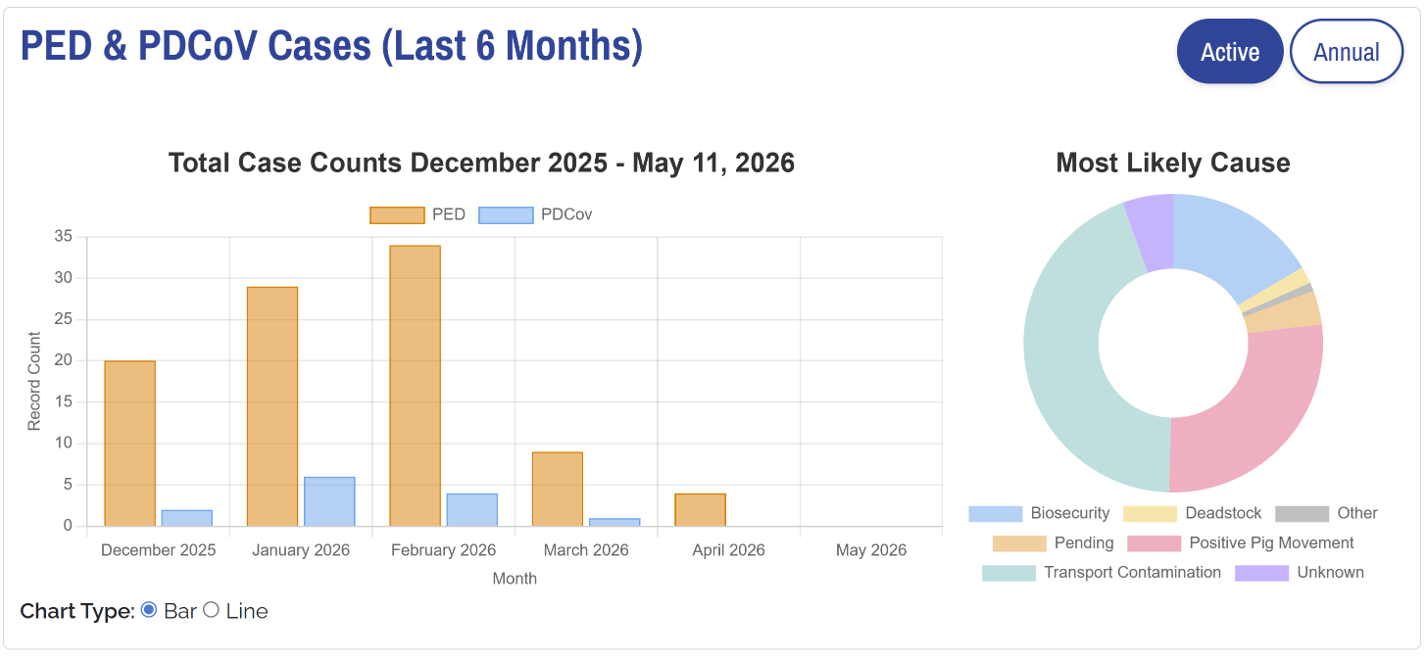
Jessica Fox from Swine Health Ontario (SHO) provided an update on PED and PDCoV during the quarter. During Q1 of 2026, there were a total of 72 new PED cases, 19 of which were movement related. There were also 11 new PDCoV cases, 7 of which were movement related. Of these cases reported during this quarter, 11 of the PED cases and 1 of the PDCoV cases have been closed. This quarter was particularly severe in terms of new porcine coronavirus cases, and many have attributed this large spike in cases because of a particularly harsh winter.
As producers spread manure this spring, SHO would like to encourage everyone to stay vigilant with biosecurity, and to be mindful of the risks associated with manure spreading and handling.
Pseudorabies (PRV) Update
On April 30, 2026, the U.S. Department of Agriculture’s Animal and Plant Health Inspection Service (APHIS) National Veterinary Services Laboratories (NVSL) confirmed a detection of antibodies to pseudorabies virus (PRV) in a small commercial swine facility in Iowa. The confirmation was made using ELISA and latex agglutination testing and was identified through routine testing rather than pre-movement surveillance.
Initial traceback efforts indicate that the five affected boars originated from an outdoor facility in Texas, where animals from that herd also subsequently tested positive for pseudorabies. APHIS is currently working with officials in both Iowa and Texas to expand traceback efforts and identify any additional potential exposures.
This detection marks the first known case of pseudorabies in commercial swine since 2004, when the disease was officially eradicated from the U.S. commercial swine industry. PRV continues to be prevalent in feral swine populations across the United States, and occasional spillover of infection into outdoor production herds remains possible where contact with feral swine occurs. APHIS is working closely with the Iowa Department of Agriculture and Land Stewardship and the Texas Animal Health Commission to better understand the detection and prevent further spread.
Importantly, this detection does not pose a risk to consumer health and does not affect the safety of the commercial pork supply. However, there may be limited, short-term impacts on exports of U.S. swine and swine genetics. Pseudorabies is a contagious viral disease of livestock and other mammals, but pigs are the only natural hosts. While PRV can infect most mammals, humans, horses, and birds are considered resistant.
Source: (USDA-APHIS. (2026, April 30). USDA Confirms Pseudorabies in Swine Herds in Iowa and Texas. U.S. Department of Agriculture, Animal and Plant Health Inspection Service. https://www.aphis.usda.gov/print/pdf/node/8128. USDA-APHIS. (2026, April 30). Pseudorabies confirmed in U.S. commercial swine herd. National Hog Farmer. https://www.nationalhogfarmer.com).
Influenza A in Swine – Animal Health Lab (AHL) Update
Influenza A (IAV)
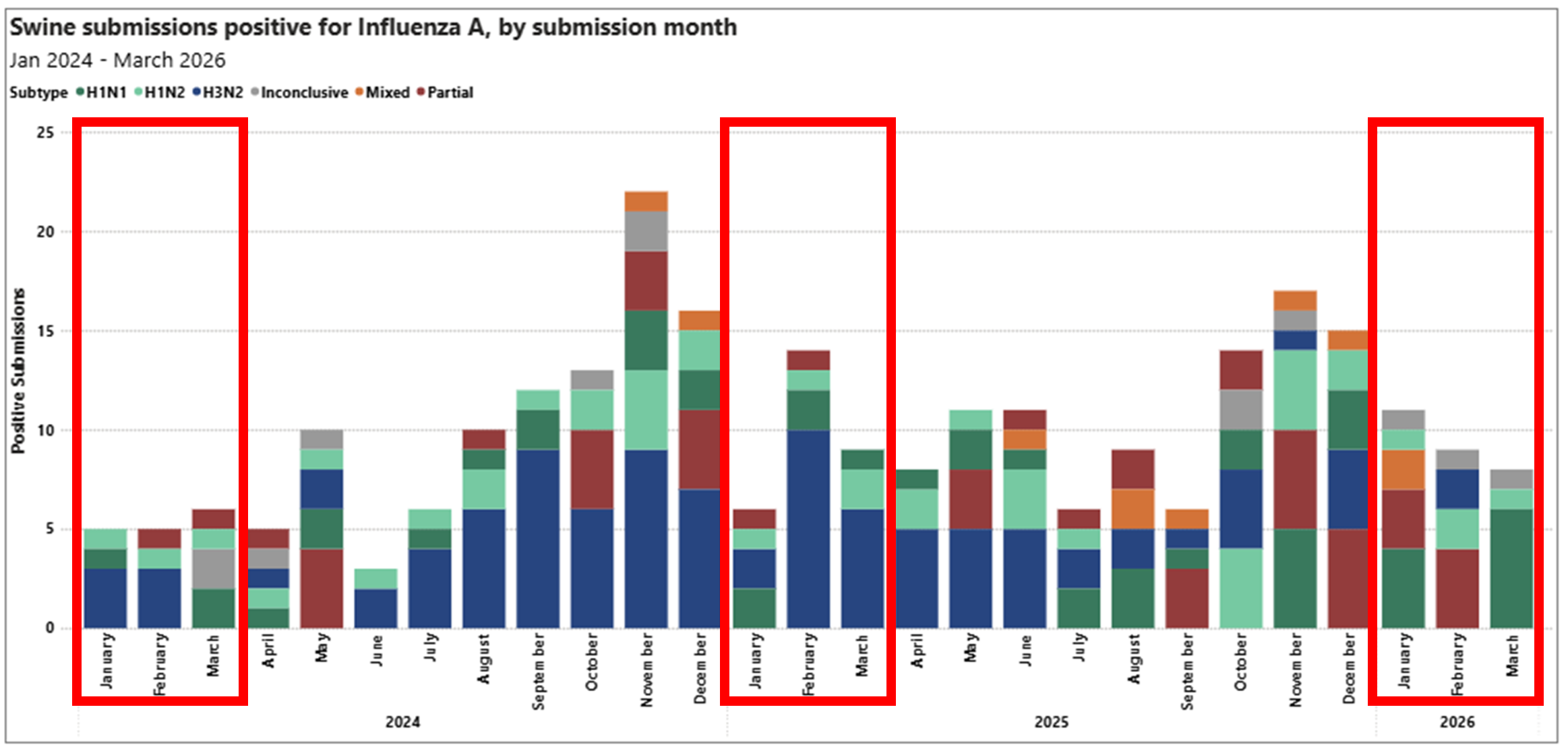
During Q1 of 2026, there were a total of 28 positive submissions, which is lower than Q4 of 2025, as well as Q1 of 2025. This quarter, the predominant subtype was H1N1, making up 36% of the positive submissions. All of these H1N1-positive submissions were of the pandemic clade. The majority of submissions were of an unspecified age group, followed by grow-finish pigs. OAHN encourages veterinarians and producers submitting samples to the AHL to include pig age in their submissions so important trends can be gathered from this data.
OAHN Projects- Now Accepting Samples!
Dr. Rebecca Egan provided an overall OAHN swine projects update. Reminder project #1 on Circovirus (PCV-2) and project #2 on Sapovirus are both now open and accepting samples!
Project #1- This project aims to assess Porcine Circovirus type 2 (PCV2) prevalence in the Ontario herd, specifically the different PCV2 subtypes. PCV2 PCR-positive samples submitted to AHL are eligible, and this project will sequence these samples to determine subtype. These results will allow for better understanding of the distribution of different PCV2 subtypes within the province. A short survey will accompany these submissions to better understand the clinical picture of each case. There have currently been 40 cases tested thus far, with the following results: 20% PCV2a, 50% PCV2d and 27.5% un-typeable (due to concurrent detection with PCV-1 in 5 of these 11 cases).
Project #2- This project focuses on the neonatal diarrhea complex and the role of Sapovirus in these cases. Eligible cases will be those with piglets less than 20d of age presenting with a clinical scour and an accompanying Sapovirus PCR-positive result. This project aims to provide a better understanding of how Sapovirus contributes to neonatal diarrhea cases, especially amongst other common pathogens. There have been 11 cases tested to date. Of these cases, 18% have tested positive for Sapovirus PCR and 36% of cases being inconclusive on Sapovirus PCR (Ct from 34 to 40). All of these positive and inconclusive cases have had co-infection with Rotavirus. Sapovirus ISH will be performed to assess for presence/distribution of viral antigen in intestinal lesions. There are still submissions needed for this project – ask your veterinarian to participate if interested! Don’t miss out on this free diagnostic testing! Any questions can be directed to Dr. Rebecca Egan eganr@uoguelph.ca.
Senecavirus A (SVA) Ontario Update
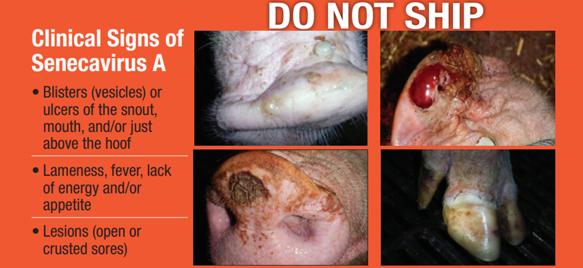
The warm weather is here and there have already been reports of vesicular type lesions found on pigs at Ontario assembly yards. SHO and OAHN would like to encourage practitioners and producers to continue to monitor herds for clinical signs, as these can be extremely subtle. Older pigs tend to present with vesicular lesions on the snout and/or coronary band(s). In a sow barn, infections can present as a very subtle scour. If a swine producer has any suspicion that there may be SVA in a swine herd, they are urged to contact their vet and the CFIA for follow-up steps!
Producers and veterinarians in all provinces need to understand that lesions can be mild and hard to notice in some animals. Diligence is required to check all animals for SVA type lesions including blisters, ulcers on the snout, ears, face, on the coronary band or between the claws on the feet before shipping them for slaughter, cull markets and/or directly for export to the USA. (Source Poster below: Swine Health Ontario)
International Disease Topics Of Interest Summary
African Swine Fever
Germany confirmed its first ASF case in wild boar in the Hochsauerland district of North Rhine-Westphalia on March 3, indicating geographic spread within the region. Since June 2025, over 37,800 wild boar have been tested, with 345 testing positive. Surveillance has been intensified using canine teams and drones.
The Catalonia outbreak in Spain continues to evolve. As of April 1, the total reached 42 outbreaks and 241 ASF-positive wild boar across 10 municipalities. Since the first detection in November 2025, 4,030 wild boar have been analyzed, with 284 testing positive. No domestic pig cases have been detected.
Foot and Mouth Disease
Foot-and-mouth disease virus (FMDV) serotype SAT1 has demonstrated a concerning expansion beyond its traditional geographic range. Historically confined to sub-Saharan Africa, SAT1 has now expanded into Western Asia, North Africa, the Eastern Mediterranean, and parts of Europe. For FMDV, immunity is serotype-specific — meaning infection or vaccination against one serotype does not confer protection against another. Most vaccination programs in newly affected regions are designed around historically occurring serotypes O, A, and Asia-1, providing no cross-protection against SAT1.
Greece confirmed its first FMD outbreak in 25 years on March 16, 2026, when a private veterinarian observed clinical signs (excessive salivation, lameness, hoof lesions) at a mixed sheep, goat, and cattle farm in Pelopi on Lesvos. By March 30, a total of 282 cases had been identified — 24 in cattle, 193 in sheep, and 65 in mixed sheep–goat herds. Authorities established 3 km protection and 10 km surveillance zones, and implemented EU-mandated whole-herd culling, movement restrictions, slaughterhouse closures, and suspended milk sales. The outbreak triggered farmer protests and port blockades in Mytilene, with civil protection emergency measures activated.
Cyprus experienced expansion to 50 herds by March 29, with the SAT1 outbreak affecting primarily sheep, goats, and cattle across 47 farms in Larnaca and Nicosia districts. More than 30,000 animals were affected, with culling reaching 28,516 sheep and goats and 1,910 cattle. Vaccination was rapidly scaled up, although vaccines for pigs remain pending. Epidemiological investigations suggest the virus likely circulated undetected for several weeks among small ruminants with subclinical infection.
On April 2, 2026, China confirmed its first-ever detection of FMD serotype SAT1. The Chinese Ministry of Agriculture reported 219 cases in cattle, involving a total of 6,229 susceptible cattle. This represents a notable change from the endemic serotypes O and A previously found in China and is particularly concerning because the country’s current vaccines offer no cross-protection against SAT1. Local governments implemented culling and disinfection measures, and the origin remains unknown — though Gansu and Xinjiang are pastoral areas, suggesting potential introduction via livestock trade routes or cross-border animal movement.
Source: (Reuters. (2026, April 2). China reports 219 cases of foot-and-mouth cattle disease in northwestern region. https://www.reuters.com. Swine Health Information Center. (2026, April 16). FMDV serotype SAT1 spread raises concerns for U.S. swine industry. National Hog Farmer / Swine Health Information Center. https://www.swinehealth.org. Yustyniuk, V., Ochwo, S., Schulte, R., & Perez, S. (2026). Swine Disease Global Surveillance Report, March 3, 2026 – April 6, 2026. Swine Health Information Center & Center for Animal Health and Food Safety, University of Minnesota. https://www.cahfs.umn.edu.)
How can you Participate in OAHN?
Share the information contained within this report with others involved in the swine industry and with other swine producers. Help us spread the word!
Ask your veterinarian for more information about topics included in this report