Ontario Animal Health Network (OAHN) Swine Network Quarterly Industry Report
Porcine Epidemic Diarrhea Virus (PED) and Porcine Deltacoronavirus (PDCoV) Ontario Update
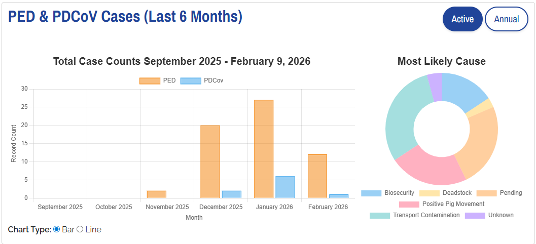
Jessica Fox from Swine Health Ontario (SHO) provided an update on PED and PDCoV cases in Ontario for Q4 of 2025. This quarter has been particularly challenging for porcine coronaviruses in the province. In Q4 of 2025, there were a total of 22 new PED cases and 2 new PDCoV cases. This contrasts dramatically with Q4 of 2024, where there were 2 new PED and 2 new PDCoV cases. Many of the cases reported this quarter were suspected to be a result of transport contamination, followed by flow-related movements of positive pigs (see SHO graph below generated on Feb 10, 2026). It is speculated that the cases started to climb in Q4 this season (compared to Q1 last season) due to the earlier influx of large snow volumes and cold temperatures. These harsh winter conditions have allowed for better preservation and movement of the virus, which is compounded with weather-related difficulties surrounding proper cleaning and biosecurity protocols. SHO would like to remind all members of the industry that it is essential to stay diligent when it comes to biosecurity measures to prevent PED and PDCoV. It takes a conscious industry-wide effort to reduce positive cases, and SHO encourages all stakeholders to continue to be conscientious in the face of these challenges!
During the last week of November, SHO ran a PED and PDCoV Awareness Week, where they provided important resources and reminders to the members of the swine industry. These resources are available on SHO’s website. The PED and PDCoV Tracking map is available on the Swine Health Ontario website and shows current and annual cases by county. http://www.swinehealthontario.ca/Disease-Information/PED-PDCoV-Tracking-Map
SHO continues to support elimination as the best strategy for disease control. Practitioners are encouraged to continue to be diligent in testing for coronaviruses in all gastrointestinal cases, as PDCoV can present with minimal clinical signs. Timely diagnosis of these cases can help limit widespread contamination and potential spread to other sites.
Senecavirus A (SVA) Ontario Update
Jessica Fox from SHO provided an update on SVA in Ontario. Cases of SVA in the province have settled back down, and all assembly sites have returned to full function with normal export status. The provincial working group is scheduled to reconvene soon to continue discussions about a provincial prevalence study. SHO and OAHN would like to encourage practitioners and producers to continue to monitor herds for clinical signs, as these can be extremely subtle. Older pigs tend to present with vesicular lesions on the snout and/or coronary band(s). In a sow barn, infections can present as a very subtle scour. If you have any suspicion that there may be SVA in your herd, please contact your vet and the CFIA for follow-up steps!
Starting in 2015, Senecavirus A (SVA) has caused intermittent complications with respect to the export of Canadian cull animals to the United States. This disease resembles reportable swine vesicular diseases. This is a national issue and since June 2025 has impacted Ontario cull sow movements.
In July 2025, the APHIS and the USDA removed the export eligibility status for a cull sow assembly in Ontario due to SVA lesions being seen in cull sows sent to a USDA processing facility. These lesions initiated foreign animal disease investigations at this US processing plant. The suspect animal(s) were initially quarantined for individual inspection and further testing. Since the initial site, more Ontario cull sow assembly sites have also had their export eligibility status revoked by APHIS and the USDA for similar reasons. The affected assembly sites accept cull sows from Quebec, the Maritimes and Ontario. Each affected assembly site has now actioned the USDA requirements including removing all animals from each site to thoroughly clean and disinfected. All Ontario cull sow assembly sites have re-gained their export status to the U.S.A. Export restrictions on these assembly sites caused disruption and had significant effects on the eastern Canadian cull sow system. Similar export issues related to SVA, have arisen previously in western Canada. It is important to continue inter-provincial industry collaboration on this issue.
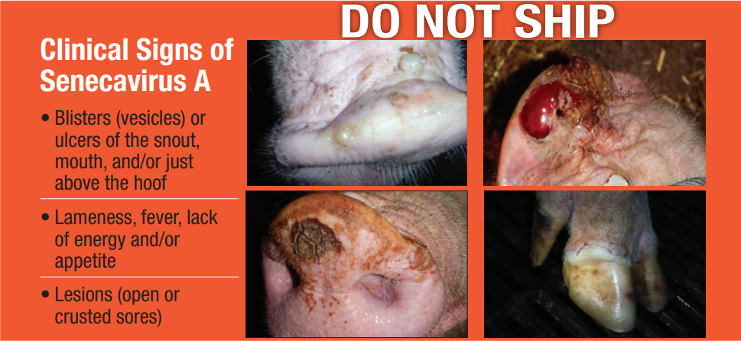
Producers and veterinarians in all provinces need to understand that lesions can be mild and hard to notice in some animals. Diligence is required to check all animals for SVA type lesions including blisters, ulcers on the snout, ears, face, on the coronary band or between the claws on the feet before shipping them for slaughter, cull markets and or directly for export to the USA. (Source Poster below: Swine Health Ontario)
SVA On-Farm Case Detection in Ontario
Drs. Conor Voth and Christa Arsenault provided an update on the one on-farm case of SVA in Ontario. This farm sent cull sows to a cull sow assembly site in Ontario and lesions were noted at the cull sow assembly site on one animal. This prompted notification to the Canadian Food Inspection Agency (CFIA) who then sampled 8 sows at the assembly site that originated from the same farm and 7/8 were positive for SVA. The CFIA also conducted an on-farm investigation at the herd of origin with the herd veterinarian present. There were no pigs with snout lesions seen at the time of this investigation and only potentially two animals that were seen with blisters near the bulbs of the heel. Diagnostic samples taken (9 sows total) by the CFIA from this farm yielded 8/9 tests positive for SVA on ELISA. The week after the CFIA conducted this on-farm inspection, the herd vet did follow-up testing and SVA was found in the breeding, farrowing and youngest pigs in the nursery, but was not found in the older groups in the nursery or the Gilt Developer Unit. The veterinarian involved reported that clinical signs of SVA were extremely mild on this farm and could easily be missed by veterinarians and producers. Loose sow housing also complicated being able to find only a few animals with clinical lesions. The initial clinical sign that presented in this herd was a scour in only a few pens of nursery pigs for 1 week in duration. Initial SVA testing was negative, and the scour was concluded to be caused by E.coli K88. All affected pigs were normal within 3-5 weeks. There was no scour in nursing piglets and no increased mortality. Some sows did go off feed for 3-4 days. The source of infection is unknown. This herd is currently working with their veterinarian on eliminating the virus.
Swine Health Ontario (SHO) has taken the lead providing SVA updates and critical messaging to Ontario swine producers and industry members. Several updates have been sent out by SHO to date and additional resources can be found on their webpage here. SVA is an immediately notifiable disease to the Ontario Ministry of Agriculture, Food and Agribusiness.
Influenza A in Swine- Animal Health Lab (AHL) Update
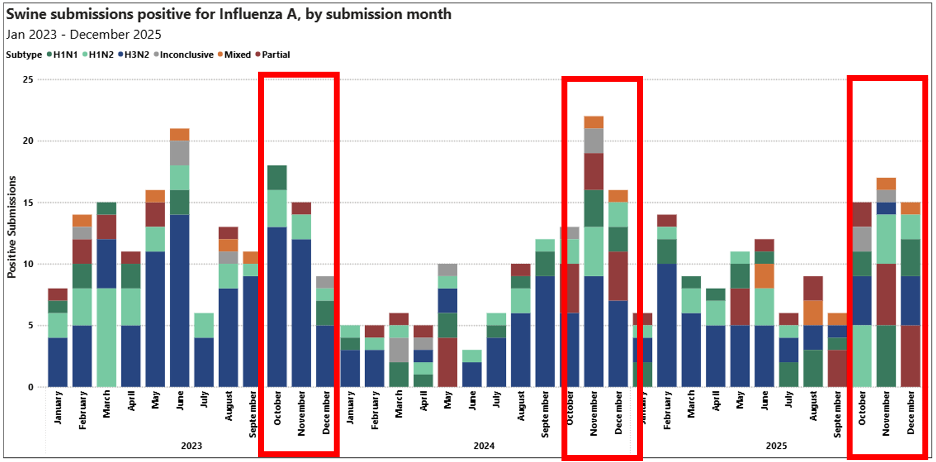
During Q4 of 2025, there were a total of 47 positive submissions. This is lower compared to Q4 of 2024, but higher than Q4 of 2023. Of the positive submissions this quarter, the majority of cases were subtypes H1N2 (23%) and H1N1 (21%), followed by H3N2 (19%). This contrasts to Q4 of the previous two years, where H3N2 was extremely dominant (43% in 2024 and 71% in 2023). The majority of submissions were of an unspecified age group, followed by grow-finish pigs. OAHN encourages veterinarians and producers submitting samples to the AHL to include pig age in their submissions so important trends can be gathered from this data.
OAHN Projects- Now Accepting Samples!
Dr. Rebecca Egan and Dr. Christa Arsenault provided an overall OAHN swine projects update. Reminder project #1 on PCV-2 and project #2 on Sapovirus are both now open and accepting samples! Please consider both when completing herd visits and or performing PM exams. Both projects will be running until June 2026 or until sample quotas are met, so practitioners are encouraged to participate when they have eligible cases.
Project #1- The first project aims to assess Porcine Circovirus type 2 (PCV2) prevalence in the Ontario herd, specifically the different PCV2 subtypes. PCV2 PCR-positive samples submitted to AHL are eligible, and this project will sequence these samples to determine subtype. These results will allow for better understanding of the distribution of different PCV2 subtypes within the province. A short survey will accompany these submissions to better understand clinical picture of each case. There have currently been 19 cases tested thus far, with the following results: 16% PCV2a, 63% PCV2d and 21% untypable.
Project #2- The second project will focus on the neonatal diarrhea complex and the role of Sapovirus in these cases. Eligible cases will be those with piglets less than 20d of age presenting with a clinical scour and an accompanying Sapovirus PCR-positive result. This project will evaluate these cases by testing for a wide range of pathogens, including porcine bacteriology enteric panel, Rotavirus PCR, Sapovirus PCR, Coronavirus triplex PCR, fecal flotation, and histopathology. This project aims to allow for better understanding of how Sapovirus contributes to neonatal diarrhea cases, especially amongst other common pathogens.
A detailed summary was sent to all OASV members in July 2025 via email and Christa provided an overview on these projects as both the OASV AGM and Fall Conference meetings. Any questions can be directed to Dr. Rebecca Egan eganr@uoguelph.ca.
International Disease Topics Of Interest Summary
Reproduction of porcine ear necrosis (ear-tip necrosis) with Fusobacterium necrophorum: Porcine ear necrosis (PEN), also known as ear-tip necrosis, is a painful and globally distributed condition affecting nursery and early grower pigs. Despite being described over 70 years ago, its cause has remained unclear, with numerous infectious and non-infectious factors proposed, including viruses, bacteria, toxins, environmental stressors, and animal behavior. This study aimed to determine whether PEN could be experimentally reproduced using defined bacterial agents under controlled conditions.
Researchers conducted three randomized, single-blinded animal trials using healthy 5-week-old pigs sourced from a high-biosecurity commercial farm with no history of PEN. Piglets were intradermally inoculated in one ear with either Staphylococcus hyicus or Fusobacterium necrophorum, while the opposite ear received sterile media as a control. In the first trial, pigs inoculated with S. hyicus—a bacterium previously suspected to play a role in PEN—failed to develop any lesions beyond mild, transient redness. All ears remained lesion-free. These findings suggest that S. hyicus alone is insufficient to induce PEN.
In contrast, trials using F. necrophorum produced lesions indistinguishable from naturally occurring PEN. The study provides the first controlled experimental evidence that PEN can be reproduced using a single, defined pathogen. The results support F. necrophorum as a primary etiological agent of PEN.
Source: Costa MdO, Nosach R, de Almeida MHM. Reproduction of porcine ear necrosis (ear-tip necrosis) following intradermal inoculation of pigs with Fusobacterium necrophorum. PLoS One. 2025;20(11):e0337536. doi:10.1371/journal.pone.0337536.
How can you Participate in OAHN?
Share the information contained within this report with others involved in the swine industry and with other swine producers. Help us spread the word!
Ask your veterinarian for more information about topics included in this report.