Ontario Animal Health Network (OAHN) Swine Network Quarterly Veterinary Report
Porcine Epidemic Diarrhea Virus (PED) and Porcine Deltacoronavirus (PDCoV) Ontario Update
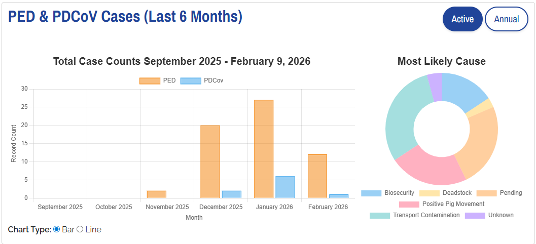
Jessica Fox from Swine Health Ontario (SHO) provided an update on PED and PDCoV cases in Ontario for Q4 of 2025. This quarter has been particularly challenging for porcine coronaviruses in the province. In Q4 of 2025, there were a total of 22 new PED cases and 2 new PDCoV cases. This contrasts dramatically with Q4 of 2024, where there were 2 new PED and 2 new PDCoV cases. Many of the cases reported this quarter were suspected to be a result of transport contamination, followed by flow-related movements of positive pigs (see SHO graph below generated on Feb 10, 2026). It is speculated that the cases started to climb in Q4 this season (compared to Q1 last season) due to the earlier influx of large snow volumes and cold temperatures. These harsh winter conditions have allowed for better preservation and movement of the virus, which is compounded with weather-related difficulties surrounding proper cleaning and biosecurity protocols. SHO would like to remind all members of the industry that it is essential to stay diligent when it comes to biosecurity measures to prevent PED and PDCoV. It takes a conscious industry-wide effort to reduce positive cases, and SHO encourages all stakeholders to continue to be conscientious in the face of these challenges!
During the last week of November, SHO ran a PED and PDCoV Awareness Week, where they provided important resources and reminders to the members of the swine industry. These resources are available on SHO’s website. The PED and PDCoV Tracking map is available on the Swine Health Ontario website and shows current and annual cases by county. http://www.swinehealthontario.ca/Disease-Information/PED-PDCoV-Tracking-Map
SHO continues to support elimination as the best strategy for disease control. Practitioners are encouraged to continue to be diligent in testing for coronaviruses in all gastrointestinal cases, as PDCoV can present with minimal clinical signs. Timely diagnosis of these cases can help limit widespread contamination and potential spread to other sites.
Senecavirus A (SVA) Ontario Update
Jessica Fox from SHO provided an update on SVA in Ontario. Cases of SVA in the province have settled back down, and all assembly sites have returned to full function with normal export status. The provincial working group is scheduled to reconvene soon to continue discussions about a provincial prevalence study. SHO and OAHN would like to encourage practitioners and producers to continue to monitor herds for clinical signs, as these can be extremely subtle. Older pigs tend to present with vesicular lesions on the snout and/or coronary band(s). In a sow barn, infections can present as a very subtle scour. If you have any suspicion that there may be SVA in your herd, please contact your vet and the CFIA for follow-up steps!
Starting in 2015, Senecavirus A (SVA) has caused intermittent complications with respect to the export of Canadian cull animals to the United States. This disease resembles reportable swine vesicular diseases. This is a national issue and since June 2025 has impacted Ontario cull sow movements.
In July 2025, the APHIS and the USDA removed the export eligibility status for a cull sow assembly in Ontario due to SVA lesions being seen in cull sows sent to a USDA processing facility. These lesions initiated foreign animal disease investigations at this US processing plant. The suspect animal(s) were initially quarantined for individual inspection and further testing. Since the initial site, more Ontario cull sow assembly sites have also had their export eligibility status revoked by APHIS and the USDA for similar reasons. The affected assembly sites accept cull sows from Quebec, the Maritimes and Ontario. Each affected assembly site has now actioned the USDA requirements including removing all animals from each site to thoroughly clean and disinfected. All Ontario cull sow assembly sites have re-gained their export status to the U.S.A. Export restrictions on these assembly sites caused disruption and had significant effects on the eastern Canadian cull sow system. Similar export issues related to SVA, have arisen previously in western Canada. It is important to continue inter-provincial industry collaboration on this issue.
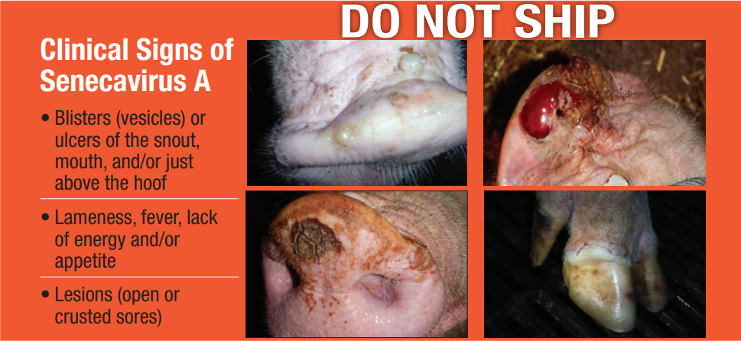
Producers and veterinarians in all provinces need to understand that lesions can be mild and hard to notice in some animals. Diligence is required to check all animals for SVA type lesions including blisters, ulcers on the snout, ears, face, on the coronary band or between the claws on the feet before shipping them for slaughter, cull markets and or directly for export to the USA. (Source Poster below: Swine Health Ontario)
SVA On-Farm Case Detection in Ontario
Drs. Conor Voth and Christa Arsenault provided an update on the one on-farm case of SVA in Ontario. This farm sent cull sows to a cull sow assembly site in Ontario and lesions were noted at the cull sow assembly site on one animal. This prompted notification to the Canadian Food Inspection Agency (CFIA) who then sampled 8 sows at the assembly site that originated from the same farm and 7/8 were positive for SVA. The CFIA also conducted an on-farm investigation at the herd of origin with the herd veterinarian present. There were no pigs with snout lesions seen at the time of this investigation and only potentially two animals that were seen with blisters near the bulbs of the heel. Diagnostic samples taken (9 sows total) by the CFIA from this farm yielded 8/9 tests positive for SVA on ELISA. The week after the CFIA conducted this on-farm inspection, the herd vet did follow-up testing and SVA was found in the breeding, farrowing and youngest pigs in the nursery, but was not found in the older groups in the nursery or the Gilt Developer Unit. The veterinarian involved reported that clinical signs of SVA were extremely mild on this farm and could easily be missed by veterinarians and producers. Loose sow housing also complicated being able to find only a few animals with clinical lesions. The initial clinical sign that presented in this herd was a scour in only a few pens of nursery pigs for 1 week in duration. Initial SVA testing was negative, and the scour was concluded to be caused by E.coli K88. All affected pigs were normal within 3-5 weeks. There was no scour in nursing piglets and no increased mortality. Some sows did go off feed for 3-4 days. The source of infection is unknown. This herd is currently working with their veterinarian on eliminating the virus.
Swine Health Ontario (SHO) has taken the lead providing SVA updates and critical messaging to Ontario swine producers and industry members. Several updates have been sent out by SHO to date and additional resources can be found on their webpage here. SVA is an immediately notifiable disease to the Ontario Ministry of Agriculture, Food and Agribusiness.
OAHN Veterinary Clinical Impression Survey Veterinary Comments
Dr. Christa Arsenault provided an overview of the practitioner survey for Q4 2025. There has been excellent participation over the past few quarters, and 18 respondents this quarter! A network personal best for respondent numbers to this survey! Thank-you to all the practitioners that responded, as your input is extremely valuable to the network and the industry!
This quarter, in terms of multi-systemic diseases, responding vets felt that there was an increase in various diseases in Q4 of 2025. 17% of practitioners perceived an increase in erysipelas, 11% perceived an increase in Glassers, 17% perceived an increase in Strep suis, and 17% perceived an increase in PCV-2. Practitioners felt that these increases throughout the quarter could likely be attributed to increases in other pathogens, specifically PRRS and Influenza.
In terms of respiratory diseases, there were major reports of increased PRRS with 47% of respondents indicated an increase in PRRS in breeding herds and 52% indicated an increase in growing herds. Prevalence of influenza was also reported to be increasing, as 64% of practitioners indicated cases were higher in Q4 of 2025. A practitioner also commented that there seemed to be a higher number of H1N1 pandemic strain cases this quarter compared to previous quarters. These increases can help explain the perceived increase in multisystemic diseases seen this quarter. Alternately, 23% of responding practitioners reported increase Mycoplasma and 11% reported increased tracheitis.
For digestive disease challenges this quarter, there was an overwhelming feeling of increased prevalence of coronaviruses this quarter with 64% of respondents indicating an increase in PDCoV and 82% indicated an increase in PED. This echo’s the data presented by Jessica Fox from SHO, as there have been an extreme number of positive cases at the end of Q4 2025.
There were some other digestive pathogens that practitioners indicated to be increased this quarter – Salmonella (17%), Rotavirus (11%), and Colibacillosis (11%). However, it was noted by the OAHN network that these perceived increases could be a result of increased testing considering the current high level of coronavirus-related scour cases in the industry during the quarter.
Animal Health Laboratory Immediately Notifiable Disease Review
Dr. Bukunmi Odebunmi from OMAFA provided a summary of the Influenza and Salmonella cases received by the AHL during Q4 of 2025.
Influenza A (IAV)
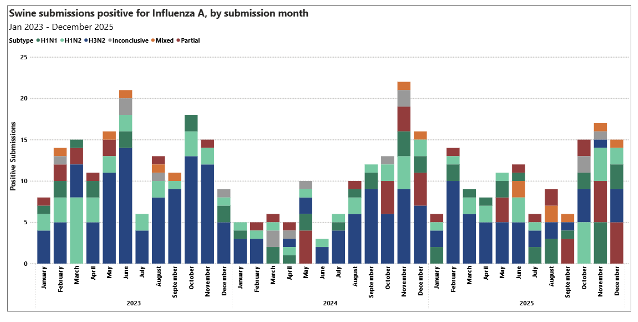
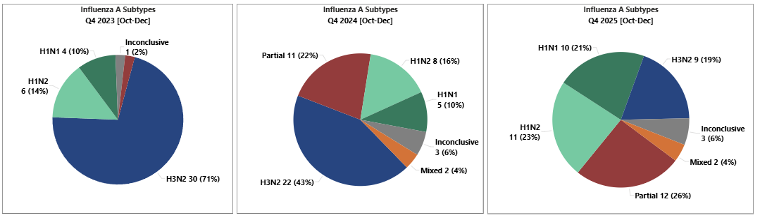
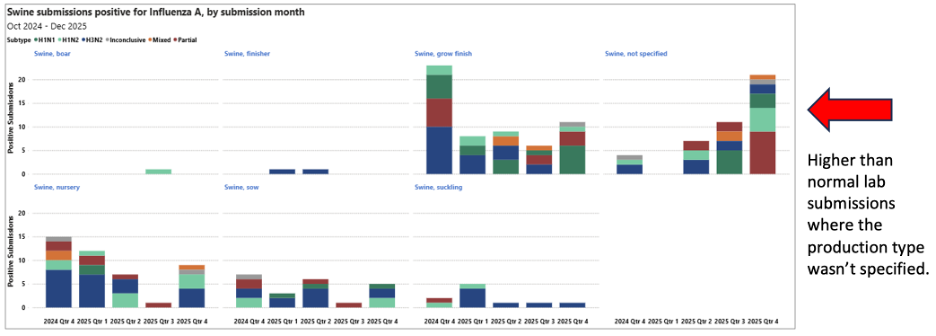
During Q4 of 2025, there were a total of 47 positive submissions. This is lower compared to Q4 of 2024, but higher than Q4 of 2023. Of the positive submissions this quarter, the majority of cases were subtypes H1N2 (23%) and H1N1 (21%), followed by H3N2 (19%). This contrasts to Q4 of the previous two years, where H3N2 was extremely dominant (43% in 2024 and 71% in 2023). The majority of submissions were of an unspecified age group, followed by grow-finish pigs. OAHN encourages practitioners to include pig age in their submissions so important trends can be gathered from this data. In terms of sequencing data, all H1N1 isolations were of the pandemic clade, and H1N2 isolations were from both the alpha and pandemic clades.
Salmonella
There were fewer positive submissions overall this quarter compared to Q4 of last year. Most of the detections this quarter were cases where Salmonella that was isolated from enrichment. More than half of the positive submissions this quarter reported gastrointestinal clinical signs. In terms of serotypes, the monophasic Salmonella Typhimurium variant was the most commonly isolated serotype, followed by Salmonella Derby. Most positive submissions continue to be predominantly isolated from nursery-age pigs.
Laboratory Diagnostic Reports
Dr. Rebecca Egan from Animal Health Lab (AHL) provided an update on cases received by the lab during Q4 2025. A total of 1,327 swine cases were submitted to the AHL this quarter. Of these,102 cases had a pathology component. A good or adequate clinical history was included for (98%) of this quarter’s pathology cases. Age group and premises ID (PID) inclusion rates for Q4 were good (not as high as usually seen with swine submissions) at 82% and 82%, respectively.
Trends and interesting cases from 2025 Q4 are as follows:
- Influenza-positive case numbers in 2025 Q4 were higher (64 cases) than in the previous 2 quarters (2025 Q2: 49 cases, 2025 Q3: 27 cases) and slightly lower than in 2024 Q4 (67 cases). H1N1 was dominant (25 cases, 24 typed as pandemic, 1 classical, and 1 beta), followed by H3N2 (14 cases) and H1N2 (15 cases).
- Porcine astrovirus 4 was detected by PCR (Ct 27.30) in one case from a pooled lung sample from pigs (nursery?) where erosive tracheitis and rhinitis and interstitial pneumonia were identified histologically, and direct testing (ISH) demonstrated the agent in trachea and lung. PCR testing was negative for influenza A. Coughing was reported over the previous 2 weeks in pigs 14 days and older with no change in mortality.
- There was 1 Senecavirus A (SVA) PCR-positive case in Q4 2025, and the last single positive case was in Q2 2025. Sows had presented with sores on the snout. Histopathology was not performed.
- In Q4 2025, there were 21 porcine Sapovirus PCR-positive submissions, representing 48% of the submissions tested. In the previous 3 quarters, positive submissions were 16 (32% of cases tested), 20 (51% of cases tested), and 26 (68% of cases tested) Q1, Q2, and Q3, respectively. The OAHN Swine Network Sapovirus Testing project may have contributed to increased detection in recent quarters.
- PRRSV was detected by PCR in 179 cases (152 diagnostic, 25 monitoring, 2 research), representing an increase from 135 positive cases in 2025 Q2 and slight decrease from 185 cases in 2024 Q4.
- There was a total of 9 abortion cases in 2025 Q4, compared to 7, 12, and 14 cases in Q4 of 2024, 2023, and 2022, respectively. Of these, 6 cases had a definitive or presumed bacterial component, and 3 were idiopathic. Bacterial agents associated with abortion were Streptococcus suis, Actinobacillus rossii, Streptococcus dysgalactiae subspecies equisimilis, Klebsiella pneumoniae, E. coli, and Salmonella Stanley.
Ontario Slaughter Statistics
Dr. Christine Pelland provided a summary of federal and provincial slaughter condemnation reports for Q4 of 2025.
Federal Slaughter Statistic Summary (Q4 Aggregate)
In total, there were 16,756 more animals slaughtered in Q4 2025 compared to Q3 2025, with 679 more condemnations. Dr. Pelland noted that compared to Q3 2025, there were reductions in condemnations resulting from abscesses (-1.1%), enteritis (-1.9%), and icterus/jaundice (-1.4%) this quarter. In contrast, there were increases this quarter in condemnations due to erysipelas (+3.9%), arthritis (+1.2%), and peritonitis (+0.5%) compared to last quarter. Of these trends, the increase in erysipelas stands out as the most dramatic; however, Dr. Pelland commented that this is not significant compared to the slaughter statistics from the past few quarters.
Provincial Slaughter Statistic Summary
The total number of hogs slaughtered provincially in Q4 of 2025 is lower compared to the previous quarter (40,178 less). This reduction is attributed to the lack of data from December of 2025. The percentage of hogs condemned also increased this quarter to 5% from 4.3% in the previous quarter. The majority of these condemned animals had parasitic livers (62.2%), which is elevated compared to all other quarters in 2025. Condemnations resulting from inflammatory conditions this quarter were reduced compared to the previous two quarters. Abscesses contributed less condemns this quarter (10.6% vs 12.6% in Q2).
CanSpotASF Surveillance Update
Dr. Christa Arsenault provided an update on the CanSpotASF surveillance submissions. Ontario samples submitted for CanSpotASF testing in 2025 Q4 included:
- Laboratory samples submitted by vets/pathologists: 16
- Provincial Abattoirs: 8
- Federal ON Abattoirs: 58
- Invasive Wild Pigs: 0
All samples tested under the CanSpotASF surveillance program have yielded negative ASF results.
OAHN Projects- Now Accepting Samples!
Dr. Rebecca Egan and Dr. Christa Arsenault provided an overall OAHN swine projects update. Reminder project #1 on PCV-2 and project #2 on Sapovirus are both now open and accepting samples! Please consider both when completing herd visits and or performing PM exams. Both projects will be running until June 2026 or until sample quotas are met, so practitioners are encouraged to participate when they have eligible cases.
Project #1- The first project aims to assess Porcine Circovirus type 2 (PCV2) prevalence in the Ontario herd, specifically the different PCV2 subtypes. PCV2 PCR-positive samples submitted to AHL are eligible, and this project will sequence these samples to determine subtype. These results will allow for better understanding of the distribution of different PCV2 subtypes within the province. A short survey will accompany these submissions to better understand clinical picture of each case. There have currently been 19 cases tested thus far, with the following results: 16% PCV2a, 63% PCV2d and 21% untypable.
Project #2- The second project will focus on the neonatal diarrhea complex and the role of Sapovirus in these cases. Eligible cases will be those with piglets less than 20d of age presenting with a clinical scour and an accompanying Sapovirus PCR-positive result. This project will evaluate these cases by testing for a wide range of pathogens, including porcine bacteriology enteric panel, Rotavirus PCR, Sapovirus PCR, Coronavirus triplex PCR, fecal flotation, and histopathology. This project aims to allow for better understanding of how Sapovirus contributes to neonatal diarrhea cases, especially amongst other common pathogens.
A detailed summary was sent to all OASV members in July 2025 via email and Christa provided an overview on these projects as both the OASV AGM and Fall Conference meetings. Any questions can be directed to Dr. Rebecca Egan eganr@uoguelph.ca.
International Disease Topics Of Interest Summary
Dr. Conor Voth reported on some interesting international and domestic disease surveillance reports and new research:
ASF – Catalonia: African swine fever (ASF) was detected in wild boar populations in Catalonia, Spain, in late 2025, with cases remaining confined to wildlife under strict surveillance and control measures. Initial detections occurred in a residential area of Cerdanyola del Vallès, where wild boar had access to food waste and dense vegetation, followed by additional carcasses at the same location and a second site near the Autonomous University of Barcelona, about 1 km away. Authorities rapidly established a 20-km infected zone with a 6-km core high-risk area, restricted wild boar movements, and launched intensive active surveillance.
By December 12, 2025, 126 wild boar carcasses had been recovered and tested. Sixteen animals across seven outbreak clusters were confirmed ASF-positive, while 110 tested negative. The affected area has moderate wild boar density and a strong urban–wildlife interface, but a relatively low density of pig farms (55 commercial holdings). Importantly, no domestic pig farms have been infected, supporting the assessment that the outbreak remains contained within wildlife.
Despite containment, the economic impact has been substantial. A slaughterhouse in Osona temporarily laid off 458 workers, marking the first labor impact linked to the outbreak. Catalonia faces nearly USD 1.2 billion in export risk and potential effects on around 11,000 jobs. While regionalization has preserved most international trade, approximately one-third of Spain’s pork exports remain suspended, leading to falling pig prices and weekly estimated losses of EUR 24 million. Farmers consider the EUR 10 million aid package insufficient.
Control measures include intensive carcass searches using field teams, dogs, drones, and helicopters; fencing and repellents to contain wild boar; hunting bans in core zones; movement restrictions and enhanced biosecurity on pig farms; and enforcement support from military and police units. All pig farms in the zone have been inspected with no clinical signs detected.
Genomic sequencing confirmed ASF virus genotype II but revealed a distinct variant with unique mutations, prompting investigation into its origin. While a laboratory-related hypothesis is being reviewed, no evidence currently confirms this source. International responses include a mix of regionalized trade restrictions, full bans by some countries, heightened feed controls, traveler alerts, and enhanced surveillance across Europe and key trading partners. Source: (SHIC, Swine Disease Global Surveillance Report, December 2025)
Serological Evidence of Highly Pathogenic Avian Influenza (H5N1) in Invasive Wild Pigs in Western Canada:
This study investigated whether invasive wild pigs (Sus scrofa) in Alberta, Canada have been exposed to Influenza A virus (IAV), particularly during the 2022–2024 highly pathogenic avian influenza (HPAI) H5N1 clade 2.3.4.4b. Pigs are of special concern in influenza ecology because they can be infected by both avian and human influenza viruses, making them potential “mixing vessels” for viral reassortment and the emergence of novel strains. The rapid expansion of wild pig populations in western Canada increases opportunities for contact with wildlife, domestic pigs, and backyard poultry, raising spillover concerns.
Between 2021 and 2024, 267 wild pigs were captured and euthanized through the Alberta Wild Boar Control Program. Lung samples were collected from all animals, and 120 serum samples were available for serological testing. Sera were first screened using a competitive ELISA to detect prior IAV exposure, followed by hemagglutination inhibition (HI) and virus neutralization (VN) assays to determine whether antibodies were consistent with exposure to swine influenza subtypes (H1/H3) or avian-origin H5 viruses.
Overall, 4.17% (5/120) of wild pigs were seropositive for IAV antibodies. All seropositive animals were detected during June 2022 or February 2024, coinciding with widespread HPAI H5N1 activity in Alberta’s wild birds, poultry, and other wildlife species. These pigs tested negative for common swine influenza subtypes but showed H5-specific antibodies, supporting exposure to H5Nx viruses consistent with the circulating HPAI H5N1 strain. No viral RNA was detected in lung tissues by qPCR, which aligns with previous evidence that influenza virus shedding in pigs is brief and that H5N1 replicates poorly in swine.
The authors suggest that exposure likely occurred through sporadic spillover from avian sources, such as scavenging infected bird carcasses, contact with contaminated environments, or interactions with backyard poultry. The low seroprevalence indicates that sustained pig-to-pig transmission is unlikely, but the findings confirm that wild pigs can become infected and survive H5N1 exposure.
The study concludes that ongoing surveillance of wild pigs is important, as their role as potential bridge hosts and mixing vessels could have implications for animal health, livestock biosecurity, and influenza virus evolution in North America. Source: (Ley Garcia O, Alkie T, van der Meer F, Berhane Y, Detmer SE, Isham IM, et al. Serological evidence of highly pathogenic avian influenza (H5N1) in invasive wild pigs in Western Canada. Transbound Emerg Dis. 2025;2025:2720469. doi:10.1155/tbed/2720469)
Molecular Epidemiology and Seroepidemiology of Oz Virus Infection in Ticks and Wild Boars in Ibaraki Prefecture, Japan: Oz virus (OZV) is an emerging tick-borne RNA virus belonging to the family Orthomyxoviridae and genus Thogotovirus. First identified in 2013 from Amblyomma testudinarium ticks in western Japan, OZV has recently raised public health concern following a suspected fatal human infection reported in Ibaraki Prefecture in 2023. This study aimed to investigate the molecular epidemiology and seroepidemiology of OZV in Ibaraki Prefecture by examining tick populations and wild boars, which are considered potential hosts.
Between April and November 2023, 2,430 ticks representing seven species were collected from 19 sites. OZV RNA was detected in a single A. testudinarium nymph collected from the central–western mountainous region of the prefecture, confirming the presence of the virus in the local tick population. In parallel, 934 serum samples from wild boars collected between 2019 and 2023 were analyzed. OZV RNA was detected in one wild boar serum sample (0.11%), indicating recent infection. Neutralizing antibodies assays revealed 243 wild boar (26%) were seropositive, demonstrating widespread exposure to OZV.
Although the high seroprevalence contrasted with the low detection rate of viral RNA, this pattern suggests frequent exposure but transient or low-level viremia in wild boars, potentially limiting their role as long-term reservoirs. Overall, this study provides the first direct evidence of OZV circulation in the natural environment of Ibaraki Prefecture, implicates A. testudinarium as the primary vector, and identifies wild boars as an important exposure host. The findings support consideration of OZV as a potential emerging zoonotic pathogen and highlight the need for further surveillance, including seroepidemiological studies in humans, to better assess public health risk. Source: (Osawa S, Kimura H, Abe S, Nagata N, Ueno E, Ebihara H, Kimura R, Furuya T. Molecular epidemiology and seroepidemiology of Oz virus infection in ticks and wild boars in Ibaraki Prefecture, Japan. Microorganisms. 2025;13:2421. doi:10.3390/microorganisms13112421.)
Reproduction of porcine ear necrosis (ear-tip necrosis) following intradermal inoculation of pigs with Fusobacterium necrophorum: Porcine ear necrosis (PEN), also known as ear-tip necrosis, is a painful and globally distributed condition affecting nursery and early grower pigs. Despite being described over 70 years ago, its cause has remained unclear, with numerous infectious and non-infectious factors proposed, including viruses, bacteria, toxins, environmental stressors, and animal behavior. This study aimed to determine whether PEN could be experimentally reproduced using defined bacterial agents under controlled conditions, thereby clarifying its etiology.
Researchers conducted three randomized, single-blinded animal trials using healthy 5-week-old pigs sourced from a high-biosecurity commercial farm with no history of PEN. Piglets were intradermally inoculated in one ear with either Staphylococcus hyicus or Fusobacterium necrophorum, while the opposite ear received sterile media as a control. Sentinel pigs were included to monitor spontaneous disease development. Animals were closely monitored for up to 21 days, with lesion severity scored daily and samples collected for bacteriology and histopathology.
In the first trial, pigs inoculated with S. hyicus—a bacterium previously suspected to play a role in PEN—failed to develop any lesions beyond mild, transient redness. All ears remained lesion-free, despite the strain carrying the exfoliative toxin gene associated with greasy pig disease. These findings suggest that S. hyicus alone is insufficient to induce PEN.
In contrast, trials using F. necrophorum produced lesions indistinguishable from naturally occurring PEN. In trial two, 4 of 10 inoculated pigs developed progressive ear necrosis with tissue loss, while in trial three, 7 of 9 pigs developed similar lesions, some as early as three days post-inoculation. The bacterium was consistently isolated from necrotic ear tissue but not from sentinel pigs. Histopathology revealed ulceration, granulation tissue, and filamentous bacteria consistent with F. necrophorum. Lesions closely mirrored those observed in commercial outbreaks.
The study provides the first controlled experimental evidence that PEN can be reproduced using a single, defined pathogen. The results support F. necrophorum as a primary etiological agent of PEN and favor an “outside-in” pathogenesis, where skin trauma—such as ear biting—allows bacterial invasion and subsequent necrosis. This aligns with field observations linking PEN to oral manipulation and environmental stress.
Although severe, complete ear loss was not consistently reproduced, the authors suggest this may require repeated exposure, higher bacterial loads, or polymicrobial interactions. Overall, the findings represent a major advance in understanding PEN, highlighting F. necrophorum as a key causative agent and providing a foundation for developing targeted prevention and control strategies that improve animal welfare while reducing reliance on antimicrobials.
Source: Costa MdO, Nosach R, de Almeida MHM. Reproduction of porcine ear necrosis (ear-tip necrosis) following intradermal inoculation of pigs with Fusobacterium necrophorum. PLoS One. 2025;20(11):e0337536. doi:10.1371/journal.pone.0337536.
How can you Participate in OAHN?
Look for the 2026 Q1 veterinary clinical impression survey that will come out the first week of April 2026 via an email through the OASV listserv.
If you are a practicing vet that sees swine in Ontario, please complete this survey when the email reminders are sent out through the OASV listserv.