Ontario Animal Health Network (OAHN) Swine Network Quarterly Veterinary Report
Senecavirus A (SVA) Ontario Update
Starting in 2015, Senecavirus A (SVA) has caused intermittent complications with respect to the export of Canadian cull animals to the United States. This disease resembles reportable swine vesicular diseases. This is a national issue and since June 2025 has impacted Ontario cull sow movements.
In July 2025, the APHIS and the USDA removed the export eligibility status for a cull sow assembly in Ontario due to SVA lesions being seen in cull sows sent to a USDA processing facility. These lesions initiated foreign animal disease investigations at this US processing plant. The suspect animal(s) were initially quarantined for individual inspection and further testing. Since the initial site, more Ontario cull sow assembly sites have also had their export eligibility status revoked by APHIS and the USDA for similar reasons. The affected assembly sites accept cull sows from Quebec, the Maritimes and Ontario. Each affected assembly site has now actioned the USDA requirements including removing all animals from each site to thoroughly clean and disinfected before they were able to regain their export status. The assembly site operators worked closely with veterinarians to develop the required SOP’s and have now completed actioning the USDA listed requirements. All Ontario cull sow assembly sites have re-gained their export status to the U.S.A, but some are still under a 60-day requirement for vet inspection on each load going to the U.S.A. After this 60-day period expires these sites will be able to export normally as long as no further SVA typical lesions are detected at U.S. processing plants. Export restrictions on these assembly sites caused disruption and had significant effects on the eastern Canadian cull sow system. Similar export issues related to SVA, have arisen previously in western Canada. It is important to continue inter-provincial industry collaboration on this issue.
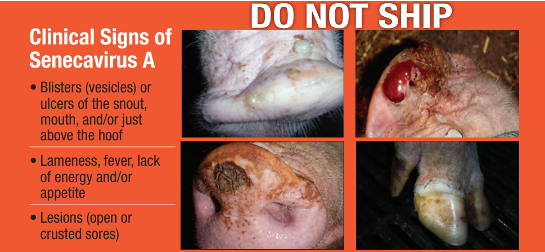
Producers and veterinarians in all provinces need to understand that lesions can be mild and hard to notice in some animals. Diligence is required to check all animals for SVA type lesions including blisters, ulcers on the snout, ears, face, on the coronary band or between the claws on the feet before shipping them for slaughter, cull markets and or directly for export to the USA. (Source Poster below: Swine Health Ontario)
SVA On-Farm Case Detection in Ontario
Dr. Christa Arsenault provided an update that there is currently one on-farm case of SVA in Ontario. This farm sent cull sows to a cull sow assembly site in Ontario and lesions were noted at the cull sow assembly site on one animal. This prompted notification to the Canadian Food Inspection Agency (CFIA) who then conducted an on-farm investigation with the herd veterinarian present. There were no pigs with snout lesions seen at the time of this investigation and only potentially two animals that were seen with blisters near the bulbs of the heel. Diagnostic samples taken by the CFIA from this farm were positive for SVA. The veterinarian involved reported that clinical signs of SVA were extremely mild on this farm and could easily be missed by veterinarians and producers. Loose sow housing also complicated being able to find only a few animals with clinical lesions. The initial clinical sign that presented in this herd was a scour in only a few pens of nursery pigs for 1 week in duration. All affected pigs were normal within 3-5 weeks. Nursery pigs from the oldest group that scoured were sent to the AHL for testing and tested SVA negative on PCR test. There was no scour in nursing piglets and no increased mortality. Some sows did go off feed for 3-4 days. The source of infection is unknown. This herd is currently working with their veterinarian on eliminating the virus.
Swine Health Ontario (SHO) has taken the lead providing SVA updates and critical messaging to Ontario swine producers and industry members. Several updates have been sent out by SHO to date and additional resources can be found on their webpage here. SVA is an immediately notifiable disease to the Ontario Ministry of Agriculture, Food and Agribusiness.
Porcine Epidemic Diarrhea (PEDV)/ Porcine Deltacoronavirus (PDCoV)
Jessica Fox the manager of Swine Health Ontario (SHO) provided an update on PED and PDCoV cases seen in Q3 of 2025. This quarter has seen a significant decrease in cases, with a total of two cases, one PED case in a finishing barn and 1 PDCoV case in a nursery-finishing barn). Both cases tested positive in early July. However, as the winter and cold weather are now here, SHO urges producers and those in the swine industry to stay vigilant with biosecurity to try to reduce the amount of PED and PDCoV cases that we see this season. During the last week of November, SHO ran a PED and PDCoV Awareness Week, where they provided important resources and reminders to the members of the swine industry as we move into winter.
SHO continues to support elimination as the best strategy for disease control. Practitioners are encouraged to continue to be diligent in testing for coronaviruses in all gastrointestinal cases, as PDCoV can present with minimal clinical signs. Timely diagnosis of these cases can help limit widespread contamination and potential spread to other sites.
Practitioners are also encouraged to promote the use of SHARC by producers to stay aware of current positive sites in their proximity. Please refer any producers interested in enrollment to Jessica Fox Jessica.fox@swinehealthontario.ca. The PED and PDCoV Tracking map is available on the Swine Health Ontario website and shows current and annual cases by county. http://www.swinehealthontario.ca/Disease-Information/PED-PDCoV-Tracking-Map
OAHN Veterinary Clinical Impression Survey Veterinary Comments
Dr. Andrea Patterson provided an overview of the practitioner survey for Q3 2025. There has been excellent participation over the past few quarters, and there were 15 respondents this quarter!
This quarter, there were no major perceived changes in the multi-systemic diseases. One practitioner commented that they found Edema disease with a Shiga toxin and strange clinical signs in a herd. In addition to this comment, 13% of respondents felt there was an increase in Edema disease this quarter.
Generally, respondents felt that there was an increase in Strep, Glassers, and PCV2 this quarter compared to last. However, this is consistent with previous Q3s, as these infections typically increase in conjunction with higher PRRS and Influenza prevalence. Practitioners also noted an increase in respiratory disease related to these two pathogens this quarter. One practitioner commented that they are seeing increased PCV2 type d and felt that they see decreased efficacy of a one-shot vaccination program in herds with a PRRS co-infection. Another practitioner noted that they have a challenging respiratory case in suckling to growing pigs where only Astrovirus-4 can be found (no PRRS or IAV found, despite similar clinical signs).
In terms of digestive diseases, 27% of respondents felt that there was an increase in rotavirus and 20% felt that there was an increase in sapovirus this quarter. One practitioner commented that they are experiencing ongoing challenges with rotavirus and sapovirus suckling pig scour and struggling to control cases adequately with the control options available. There was an overwhelming decrease in PED and PDCoV cases, which Jessica Fox confirmed with current SHO case counts. One practitioner reported a case of hemorrhagic bowel syndrome, which they commented was likely related to hot weather and decreased feed intake.
Animal Health Laboratory Immediately Notifiable Disease Review
Dr. Bukunmi Odebunmi from OMAFA provided a summary of the Influenza and Salmonella cases received by the AHL during Q3 of 2025.
Influenza A (IAV)
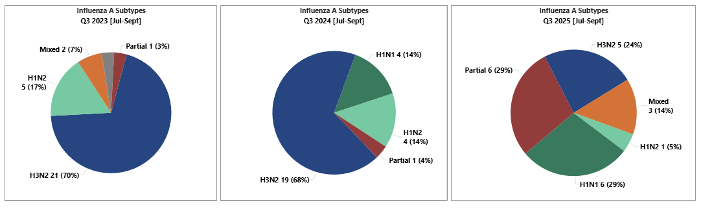
There were 22 positive case submissions for Influenza A in Q3 of 2025. This is lower compared to Q3 of 2024 and Q3 in 2023. For this quarter, partial (29%) and H1N1 (29%) subtypes were the most dominant, followed by H3N2 (24%). This differs from Q3 of 2024 and 2023, where H3N2 was the most dominant subtype (68% and 70%, respectively). Most of the IAV detections this quarter were from “non-specified” age, followed by grow-finish pigs. All H1N1 isolations were of the pandemic clade, and most of the H3N2 isolations were of the 2010.1 clade. (See graphs below and top of next page)

Salmonella
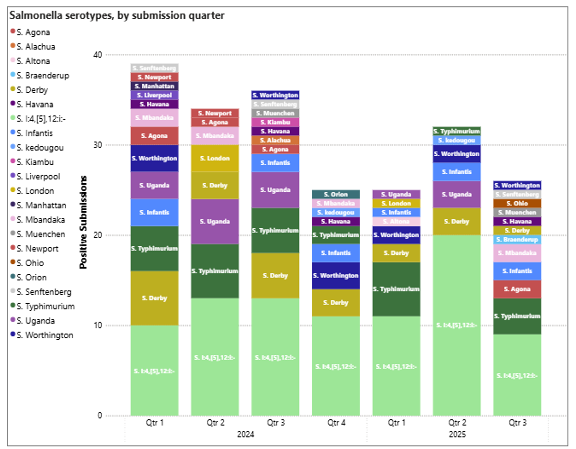
For Q3 of 2025, there was a steady distribution of Salmonella-positive cases across the quarter. There were fewer overall cases this quarter compared to Q3 of 2024. The majority of cases this quarter were isolated from enrichment (IFE), and there was a notable reduction in cases with 3+ and 4+ growth this quarter compared to last quarter (Q2 2025). More than half of the Salmonella-positive cases this quarter reported GI clinical signs. The most commonly isolated serotype was the monophasic Typhymurium serotype, which is consistent with last quarter. However, there was a notable increase in serotype diversity this quarter compared to Q1 and Q2 of this year. The majority of cases this quarter were from nursery pigs. (See graph below that demonstrates serotypes detected).
Laboratory Diagnostic Reports
Dr. Josepha DeLay from Animal Health Lab provided an update on cases received by the lab during Q3 2025. A total of 1,250 swine cases were submitted to the AHL this quarter. Of these, 80 cases had a pathology component. A good or adequate clinical history was included for (99%) of this quarter’s pathology cases. Age group and premises ID (PID) inclusion rates for Q3 were excellent at 96% and 90%, respectively.
Trends and interesting cases from 2025 Q3 are as follows:
- Influenza-positive case numbers in 2025 Q3 were lower (27 cases) than in the previous 2 quarters (2025 Q1: 68 cases, 2025 Q2:49 cases) and in 2024 Q3 (42 cases) and were similar to those in 2024 Q1 and Q2. H3N2 (14 cases) and H1N2 (14 cases) subtypes were dominant and equally prevalent, with few H1N1-positive cases (3).
- PRRSV was detected by PCR in 135 cases (112 diagnostic, 22 monitoring, 1 research), representing a slight decrease from 159 positive cases in 2025 Q2 and 148 cases in 2024 Q3.
- Systemic vascular mineralization was identified in a pig from a 2,400 head finisher herd. Hypercalcemia was detected in a second pig sampled. Vitamin D toxicity was considered likely but not confirmed (feed mixing error vs vitamin D rodenticide).
- Porcine astrovirus 4 was detected by PCR (Ct 22.65) in a nursery pig from a group with mild tracheitis. No direct testing (ISH) was pursued.
- Brachyspira hyodysenteriae was detected by PCR in 2 cases, 1 of which was from grower pigs in Ontario (second case originated from an external lab, with no herd information provided). The clinical history for the grower pigs described loose manure while maintaining good condition. B.pilosicoli was identified by PCR in 1 case (same external B.hyodysenteriae case).
- Skin lesions consistent with swinepox were identified in neonatal piglets in 1 herd.
- Abortion cases were few this quarter (2 cases), and this slump tends to be consistent for Q3 in each year.
- A congenital cardiac anomaly (aortic stenosis) was identified in a Kunekune pig.
Gallant Custom Laboratory (CEVA) Diagnostic Reports
Kevin Millsap from Gallant Custom Laboratories (CEVA) provided an update on cases for Q3 2025. They had one case this quarter, where Staphylococcus aureus was isolated.
Ontario Slaughter Statistics
Dr. Christine Pelland provided a summary of federal and provincial slaughter condemnation reports for Q3 of 2025.
Federal Slaughter Statistic Summary (Q3 Aggregate)
In total, there were 13,366 fewer animals slaughtered in Q3 2025 compared to Q2 2025, with 14 fewer condemnations. Compared to the previous quarter, there was a reduction in condemnations attributed to arthritis (-1.1%), pneumonia (-0.9%), and enteritis (-0.1%). Conversely, there was an increase in condemnations this quarter due to peritonitis (+5%), abscesses (+4.7%), icterus/jaundice (+2.2%), and septicemia (+1.2%) compared to Q2 of 2025.
Provincial Slaughter Statistic Summary
There was an increase in total number of hogs slaughtered in Q3 of 2025 compared to last quarter, with an increase in around 6,500 hogs. This corresponded to a 4.3% increase in condemnations for the quarter,
The majority of condemned animals in Q3 had parasitic livers (54.1%), consistent with Q2 & Q1 of 2025. Condemnations resulting from inflammatory conditions are consistent with the previous 2 quarters. Abscesses contributed less condemnations as a percentage (10.3% vs. 12.6%) in Q3 compared to Q2. The ‘Other’ category represented 6.3% of condemnations in Q3 2025, compared to 9.0% in Q3 of last year (2024).
CanSpotASF Surveillance Update
Dr. Christa Arsenault provided an update on the CanSpotASF surveillance submissions. Ontario samples submitted for CanSpotASF testing in 2025 Q3 included:
- Laboratory samples submitted by vets/pathologists: 24
- Provincial Abattoirs: 2
- Federal ON Abattoirs: 46
- Invasive Wild Pigs: 0
All samples tested under the CanSpotASF surveillance program have yielded negative ASF results.
OAHN Projects- Now Accepting Samples!
Dr. Josepha DeLay and Dr. Christa Arsenault provided an overall OAHN swine projects update. Reminder project #1 on PCV-2 and project #2 on Sapovirus are both now open and accepting samples! Please consider both when completing herd visits and or performing PM exams. Both projects will be running until June 2026, so practitioners are encouraged to participate when they have eligible cases.
Project #1- The first project aims to assess Porcine Circovirus type 2 (PCV2) prevalence in the Ontario herd, specifically the different PCV2 subtypes. PCV2 PCR-positive samples submitted to AHL are eligible, and this project will sequence these samples to determine subtype. These results will allow for better understanding of the distribution of different PCV2 subtypes within the province. A short survey will accompany these submissions to better understand clinical picture of each case. There have currently been 19 cases tested thus far, with the following results: 16% PCV2a, 63% PCV2d and 21% untypable.
Project #2- The second project will focus on the neonatal diarrhea complex and the role of Sapovirus in these cases. Eligible cases will be those with piglets less than 20d of age presenting with a clinical scour and an accompanying Sapovirus PCR-positive result. This project will evaluate these cases by testing for a wide range of pathogens, including porcine bacteriology enteric panel, Rotavirus PCR, Sapovirus PCR, Coronavirus triplex PCR, fecal flotation, and histopathology. This project aims to allow for better understanding of how Sapovirus contributes to neonatal diarrhea cases, especially amongst other common pathogens.
A detailed summary was sent to all OASV members in July 2025 via email and Christa provided an overview on these projects as both the OASV AGM and Fall Conference meetings. Any questions can be directed to Dr. Christa Arsenault christa.Arsenault@ontario.ca
OVC Research Update
Dr. Zvonimir Poljak provided an update on projects currently underway at the University of Guelph. Please contact any of the listed contributors if you would like additional information.
Comparing two methods of injection in piglets: needle-free injection vs needle-syringe injection: This project is currently being worked on by advisor/principal investigator Dr. Terri O’Sullivan and graduate students Minh Man Pham and Alexis Buzby.
Expected outcomes: The needle-free injection technology is expected to optimize animal welfare and current practices during piglet processing.
Sow mortality study: This project currently involves the PhD candidate Reshat Jashari, advisors Dr. Terri O’Sullivan and Dr. Anne Deckert.
Expected outcomes: To support the industry with evidence-based recommendations to reduce sow mortality, and to improve sow health, productivity, and welfare across the swine industry.
Microbiome Projects: Vahab Farzan is currently the Principal Investigator for the following microbiome-focused projects:
- A pan-Canadian study investigating the virulence factors in enterotoxigenic E.coli (ETEC) isolates associated with post-weaning diarrhea, the gut microbiome in diarrheic vs health pigs, and genetic susceptibility to ETEC infection in pigs on Canadian farms
- A sow/piglet study to determine the effect of microbiome and the passive transfer of immunity of sows (which are supplemented postbiotics) on the microbiome, immune response, and disease resilience of piglets
- Integrated approaches to replace antimicrobials and promote health in weaned piglets aiming to evaluate the effectiveness of bacteriophage endolysis and probiotics in controlling of the diseases associated with Streptococcus suis
Other Projects: Dr. Zvonimir Poljak is the Principal Investigator of a variety of other projects:
- Expanding Ontario Interactive Pathogen Dashboards– A collaboration with AHL, there are 21-pathogen/host dashboards. The current focus is zoonotic pathogens (Influenza, Leptospira, Coxiella, abortions, syndromic surveillance).
- H5N1 Genomic Risk Assessment– A collaboration with Dalhousie and National Center of Foreign Animal Disease (NCFAD). The current focus is the classification of H5Nx genotypes.
- Development of AMR Dashboards for Easy Analysis– Collaboration with Cornell and 4 other universities. Current focus is the incorporation of MIC values.
- H5N1 Risk Assessment (in barn and between species)– Collaboration with NCFAD.
- Epidemiological Analysis of 2023 ASF Outbreak in Croatia – collaboration with Croatian Veterinary Institute and MAFF. The focus is on space-time patterns, morbidity and mortality, clinical signs.
International Disease Topics Of Interest Summary
Dr. Conor Voth reported on some interesting international and domestic disease surveillance reports and new research:
Prions in Pigs: Prions are abnormally folded proteins capable of inducing misfolding in normal proteins of the same type. In animals, this process causes progressive neuronal damage, ultimately leading to death. All known prion diseases in mammals target the brain and nervous tissue, resulting in fatal neurodegenerative disorders. Notable examples include Creutzfeldt–Jakob disease in humans and bovine spongiform encephalopathy (BSE), commonly known as mad cow disease, in cattle. There are currently no effective treatments or cures for prion diseases, and the mortality rate is 100%. Prions are exceptionally stable and resistant to heat, chemical disinfectants, ultraviolet and ionizing radiation, and enzymatic degradation by proteases. They can persist in the environment for years, maintaining their infectious potential. To date, no natural prion disease has been identified in pigs.
Researchers experimentally exposed pigs to prions from three other species; cattle (Bovine Spongiform Encephalopathy), sheep (Scrapie), and deer (Chronic Wasting Disease). They wanted to determine if pigs can carry prions in their brains and edible muscle tissue and see if pig-adapted prions could potentially affect humans. They tested tissues with lab methods that detect prion “seeding” (signs that prions can multiply).
BSE-exposed pigs had the highest prion levels and strongest seeding in the brain. They also had detectable prions in certain muscles (e.g., semitendinosus/leg), sometimes even at high dilutions (meaning relatively abundant prions). Scrapie-exposed pigs showed prions too, but generally weaker signals, most often in the masseter (cheek) muscle; diaphragm and tenderloin were less often positive. CWD-exposed pigs had the lowest and most inconsistent signals; some brains and few muscles showed seeding.
When researchers mixed pig tissues with human prion protein in vitro, pig-adapted BSE caused the human protein to misfold, while pig-adapted scrapie and CWD did not misfold human protein under the same conditions.
The experimental conditions used to study prion infection in pigs and human protein misfolding were not representative of natural exposure scenarios. However, the findings underscore the critical importance of maintaining strict biosecurity measures and preventing cross-species contamination to minimize potential prion transmission risks. Source: (Bravo-Risi F, Brydon F, Chong A, Spicker K, Greenlee JJ, Telling G, Soto C, Pritzkow S, Barria MA, Morales R. 2025. Infectious prions in brains and muscles of domestic pigs experimentally challenged with the BSE, scrapie, and CWD agents. mBio 16:e01800-25.https://doi.org/10.1128/mbio.01800-25)
Senecavirus A (SVA) In Buffalo
This study investigated whether a strain of Senecavirus A (SVA) originally isolated from a buffalo with mouth ulcers in China in 2018 could infect both piglets and buffaloes, and how severe the resulting disease might be.
Researchers experimentally infected eleven piglets and nine buffaloes with different concentrations of the buffalo-origin SVA strain (SVA/GD/China/2018). Each experimental group received either a high, medium, or low dose of the virus. The animals were exposed through the nose, mouth, and a small injection into muscle tissue. Over two weeks, the team monitored them for blisters on the mouth, nose, and feet, changes in appetite or behavior, body temperature, weight gain, and virus shedding in oral, nasal, and fecal samples.
The results showed that piglets developed clear signs of vesicular disease at all dose levels. Blisters formed on the lips, snout, and around the hooves, and some hoof nails detached or became necrotic. Symptoms began within two to four days after infection and peaked around day six to eight. Interestingly, the medium-dose group showed the most severe clinical scores, suggesting that the relationship between viral dose and disease severity is not strictly linear. Infected piglets gained weight more slowly than controls, and viral RNA was detected mainly in oral swabs for up to twelve days. Laboratory testing confirmed SVA antigens in lung and blister tissues, and live virus was successfully isolated from swab samples.
In buffaloes, the disease was milder but still noticeable. Blisters appeared on the lips, gums, and hoof areas, with symptoms emerging by day two or three and peaking around day nine or ten. Virus shedding was most pronounced in oral and nasal secretions, while fecal shedding was shorter and less consistent. Tissue analysis from one severely affected buffalo showed viral presence in several organs, particularly in the digestive tract, and strong viral antigen signals in blistered lip tissue. Overall, the findings demonstrate that the buffalo-origin SVA strain can infect and cause disease in both buffaloes and pigs, indicating the potential for cross-species transmission. While buffaloes showed milder illness, the ability of this strain to cross from one livestock species to another highlights the need for enhanced surveillance in cattle and buffalo populations and for improved diagnostic methods to distinguish SVA from foot-and-mouth disease in field cases. Source: (Zhou, X., Zhai, Q., Niu, J., Li, G., Chen, T., Li, Y., Kang, H., Li, C., Gou, H., Chu, P., Zhang, K., Jiang, Z., Bian, Z., Liao, M., & Zhai, S.-L. (2025). Pathogenicity of the first buffalo-origin Senecavirus A in conventional piglets and buffaloes. Transboundary and Emerging Diseases. Advance online publication. https://doi.org/10.1155/tbed/6222217)
African Swine Fever (ASF) in Taiwan
In October 2025, Taiwan confirmed its first outbreak of African swine fever (ASF) on a domestic pig farm in Wuqi District, Taichung City. The affected farm, housing around 300 mixed-age pigs, practiced swill feeding for sows (the practice of feeding food waste, such as kitchen scraps) and used commercial feed for piglets. Laboratory tests conducted at the Veterinary Research Institute confirmed ASF via PCR on October 21, followed by virus isolation on October 25. Tracing investigations revealed that pigs had been purchased from Tanzi District in late September, though no abnormal deaths were reported from the source or related farms. Transport records indicated two vehicles visiting multiple farms linked to the outbreak, prompting epidemiological surveillance across seven associated sites. Early findings pointed to inadequately cooked swill as the likely source of infection.
Upon confirmation, authorities implemented strict containment measures, including a movement control order and culling of all pigs on the affected premises. Carcasses were safely disposed of, followed by comprehensive cleaning and disinfection. A 3-km control zone encompassing two nearby farms was established, restricting pig movement and initiating intensified monitoring and biosecurity measures. As of the latest update, no additional outbreaks or unusual mortality have been detected, and surveillance remains ongoing.
Before this event, Taiwan’s pork industry had regained strong export momentum after achieving freedom from ASF, classical swine fever (CSF), and foot-and-mouth disease (FMD). The country resumed fresh pork exports to the Philippines in 2023 and to Singapore in 2025, with ongoing negotiations to expand into Japan and the U.S. The ASF outbreak now poses a major threat to these gains, with potential economic losses estimated at 200 billion NTD (about $6.4 billion USD). This figure accounts for production losses, culling, trade disruptions, and downstream economic impacts—comparable to the devastating 1997 FMD outbreak.
This incident represents a major setback for Taiwan’s swine health achievements, highlighting the persistent risks of swill feeding and the need for rigorous biosecurity, surveillance, and international disease-prevention collaboration to protect its hard-won disease-free status. Source: (SHIC, Swine Disease Global Surveillance Report, November 2025)
Swine Brucellosis In Denmark
Brucella suis is a bacterium that causes swine brucellosis, a zoonotic disease primarily affecting pigs. It leads to chronic inflammation in the reproductive organs, often resulting in abortion in pregnant sows, as well as orchitis, infertility, lameness, paralysis, and abscesses. Transmission occurs mainly through ingestion of infected tissues or fluids, contaminated semen during breeding, and nursing from infected animals. In the United States, B. suis was the first biological agent weaponized in 1952 and was field-tested with B. suis-filled bombs.
After 25 years without cases, Denmark confirmed an outbreak of Brucella suis biovar 2 in a free-range pig herd in Herning on August 22, 2025, verified by France’s ANSES reference laboratory. The herd of 3,850 pigs showed reproductive losses but no deaths, prompting testing earlier in August. The outbreak raises economic and zoonotic concerns, though no human infections have been reported. The source remains unknown, but B. suis biovar 2 is endemic in wild boar and European hares, common infection sources for domestic pigs. Denmark’s outdoor pig farms use double fencing, and while wild boar are absent, stray animals from neighboring countries are occasionally culled. The incident has disrupted trade, invalidating Denmark’s five-year brucellosis-free export exemption and suspending pig movements within the EU, except from farms with strict indoor housing and biosecurity. The Danish Veterinary and Food Administration is now developing a pre-movement monitoring program to restore certification and export capacity. Source: (SHIC, Swine Disease Global Surveillance Report, September 2025)
How can you Participate in OAHN?
Look for the 2025 Q3 veterinary clinical impression survey that will come out the first week of Oct via an email through the OASV listserv.
If you are a practicing vet that sees swine in Ontario, please complete this survey when the email reminders are sent out through the OASV listserv.